Decode a statement line
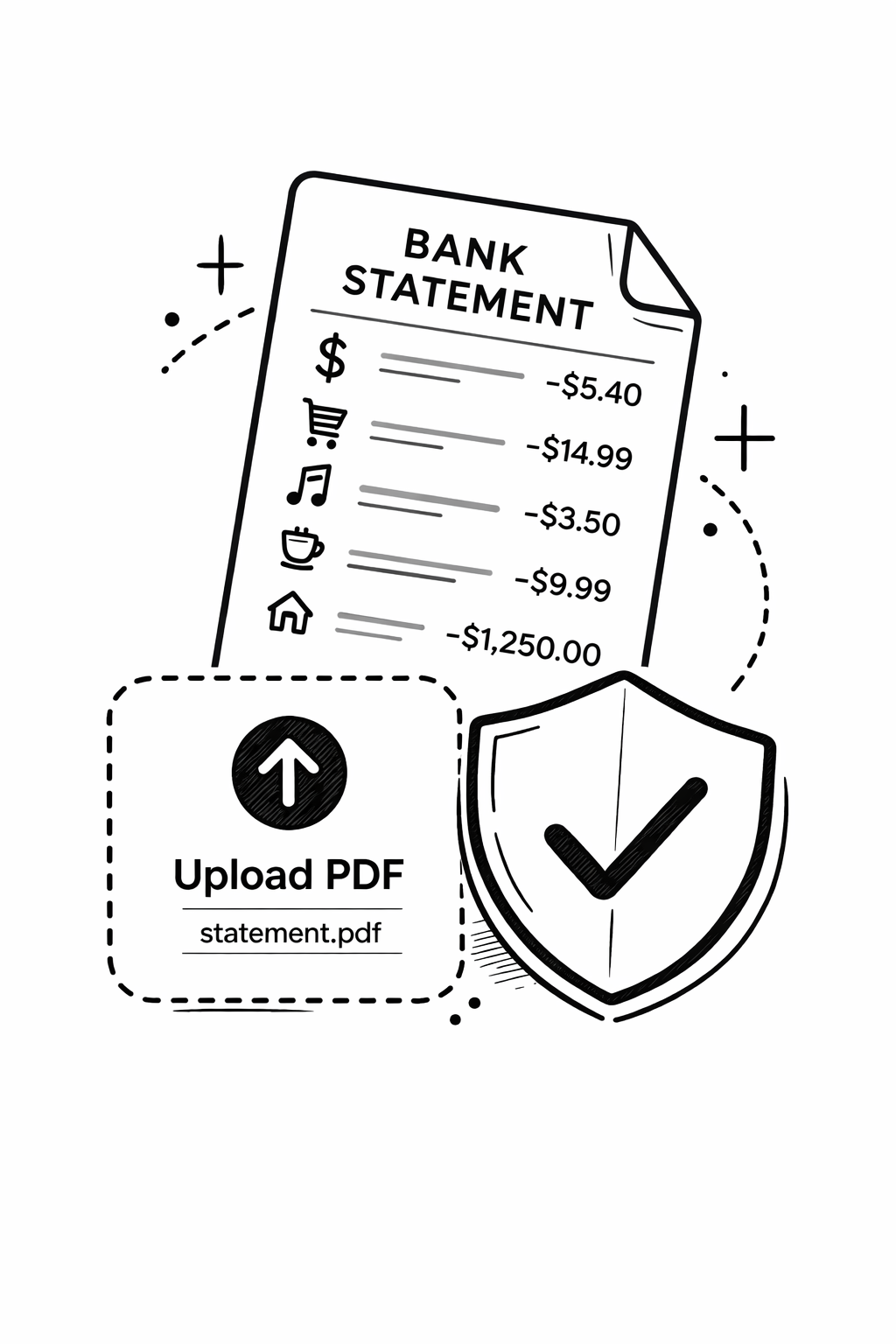
Paste a descriptor or upload the full PDF to identify deposits, fees, and unfamiliar charges.
No signup · deleted after analysis
Bank Statement Terms
Bank statement charges explained

Every common bank charge on your statement — what it is, what it typically costs in the US and UK, and how to avoid it. Nine fees covered.
Every common bank charge decoded
The table below covers nine bank charges that appear most frequently on statements. Click through to the full detail below the table for context on each one.
| Charge | How to avoid |
|---|---|
| Monthly maintenance fee | Maintain the minimum monthly balance, set up a qualifying direct deposit, or switch to a fee-free account (most UK banks; US online banks like Ally or Marcus). |
| Overdraft fee | Set up low balance alerts, link a savings account as overdraft protection, opt out of debit card overdraft coverage (US), or maintain a buffer in your account. |
| NSF (non-sufficient funds) fee | Keep a buffer in your account before scheduled payments. Review upcoming direct debits in your banking app and top up the account beforehand. |
| Wire transfer fee (outgoing) | Use ACH (US) or Faster Payments (UK) for domestic transfers — both are free. For international transfers, use Wise, Revolut, or your bank's own international app rather than a branch SWIFT wire. |
| Wire transfer fee (incoming) | Check your bank's incoming wire fee before asking someone to wire funds to you. Provide an ACH or Faster Payments alternative where possible. |
| Foreign transaction fee | Use a fee-free travel card (Charles Schwab, Capital One Venture in the US; Starling, Monzo, Wise card in the UK) for overseas spending. |
| ATM fee (out-of-network) | Use your bank's in-network ATMs, withdraw cash at supermarket tills (cashback), or switch to a bank that reimburses ATM fees (Charles Schwab US, Starling UK). |
| Paper statement fee | Switch to paperless statements (e-statements) in your online banking settings. You can still download a PDF statement from your account at any time. |
| Dormancy / inactivity fee | Make at least one transaction (even a small purchase) per year on any account you wish to keep active. Set a calendar reminder if you hold backup accounts. |
Each charge in detail
Monthly maintenance fee
A flat monthly charge for holding the account. Common on basic current accounts and US checking accounts that don't meet minimum balance or activity requirements.
US typical cost
$5–$25/month
UK typical cost
£0–£20/month (most standard current accounts are free)
Maintain the minimum monthly balance, set up a qualifying direct deposit, or switch to a fee-free account (most UK banks; US online banks like Ally or Marcus).
Overdraft fee
Charged when your balance goes below zero and the bank covers the transaction. May appear per transaction or per day you remain overdrawn.
US typical cost
$25–$35 per item (some banks have capped or eliminated this fee)
UK typical cost
Interest on the overdrawn balance at an advertised APR (typically 19–40% EAR). Unarranged overdraft fees were reformed in 2020.
Set up low balance alerts, link a savings account as overdraft protection, opt out of debit card overdraft coverage (US), or maintain a buffer in your account.
NSF (non-sufficient funds) fee
Charged when a payment — cheque, direct debit, or pre-authorised payment — is returned unpaid because the account lacks sufficient funds. Different from an overdraft fee in that the transaction is rejected rather than covered.
US typical cost
$25–$35 per returned item
UK typical cost
£0–£35 per returned item; many UK banks have removed this fee
Keep a buffer in your account before scheduled payments. Review upcoming direct debits in your banking app and top up the account beforehand.
Wire transfer fee (outgoing)
Charged when you send a bank wire transfer domestically or internationally. Domestic wires are faster than ACH but more expensive; international wires (SWIFT) carry the highest fees.
US typical cost
Domestic: $15–$30. International: $25–$50
UK typical cost
£15–£35 for international SWIFT transfers. Domestic CHAPS transfers: £15–£30
Use ACH (US) or Faster Payments (UK) for domestic transfers — both are free. For international transfers, use Wise, Revolut, or your bank's own international app rather than a branch SWIFT wire.
Wire transfer fee (incoming)
Some banks charge a fee to receive an international wire transfer into your account. Domestic incoming wires are usually free.
US typical cost
$0–$15 for incoming domestic; $0–$16 for incoming international
UK typical cost
Usually free for Faster Payments; some banks charge £5–£10 for incoming SWIFT
Check your bank's incoming wire fee before asking someone to wire funds to you. Provide an ACH or Faster Payments alternative where possible.
Foreign transaction fee
A percentage charge applied to any purchase made in a foreign currency or processed through a foreign bank. Applied by your bank on top of the card network's exchange rate.
US typical cost
1%–3% of the transaction amount
UK typical cost
2.75%–2.99% (most UK banks); 0% on Starling, Monzo, Chase UK
Use a fee-free travel card (Charles Schwab, Capital One Venture in the US; Starling, Monzo, Wise card in the UK) for overseas spending.
ATM fee (out-of-network)
Charged when you withdraw cash from an ATM that is not in your bank's network. May include a fee from your own bank plus a surcharge from the ATM operator.
US typical cost
$2.50–$5 from your bank + $2.50–$3.50 ATM surcharge
UK typical cost
Free at most UK ATMs; some independent ATMs charge £1.50–£2.50 per withdrawal
Use your bank's in-network ATMs, withdraw cash at supermarket tills (cashback), or switch to a bank that reimburses ATM fees (Charles Schwab US, Starling UK).
Paper statement fee
A charge for receiving a printed monthly bank statement by post rather than accessing statements digitally online.
US typical cost
$1–$5/month
UK typical cost
£1–£3/month with some banks
Switch to paperless statements (e-statements) in your online banking settings. You can still download a PDF statement from your account at any time.
Dormancy / inactivity fee
Charged when an account has had no transactions for a prolonged period (typically 12–24 months). The bank may also block the account until you contact them.
US typical cost
$5–$20/month after 12–24 months of inactivity
UK typical cost
Varies; some banks close or transfer dormant accounts to the government unclaimed asset scheme after 15 years
Make at least one transaction (even a small purchase) per year on any account you wish to keep active. Set a calendar reminder if you hold backup accounts.
How to dispute an incorrect bank charge
If a charge appears on your statement that you believe is incorrect, you have the right to dispute it. The process is straightforward:
Identify the charge and its date
Note the exact description, amount, and date of the charge. Upload your statement to our analyzer to get every transaction categorized and labelled — making it easier to spot fees and their context.
Check your fee schedule
Every bank publishes a schedule of fees (in the US, this is the account agreement; in the UK, it is the Summary Box or Personal Current Account Information). Confirm whether the charge matches a disclosed fee or appears to be an error.
Contact your bank directly
Call the number on the back of your card or visit a branch. Explain that you believe the charge is incorrect (or ask for a goodwill waiver on a legitimate but unexpected fee). Keep a note of the call date, agent name, and outcome.
Escalate if unresolved
In the US, file a complaint with the Consumer Financial Protection Bureau (CFPB) at consumerfinance.gov. In the UK, escalate to the Financial Ombudsman Service if the bank does not resolve it within 8 weeks. Both are free to use.
Free tool · 30 seconds · No signup
See exactly what fees hit your account
Upload your bank statement and get every transaction categorized automatically — including all bank charges, fees, and interest payments. Free, no account needed.
Common questions
What are bank charges on a bank statement?
Bank charges are fees your bank deducts directly from your account and lists as line items on your statement. They appear as debits, typically labelled with descriptions like 'MONTHLY FEE', 'OVERDRAFT CHARGE', 'WIRE FEE', or similar. They reduce your balance in the same way a purchase does, but the money goes to your bank rather than a merchant.
Can I get bank fees refunded?
Yes — in many cases, especially if you are a long-standing customer or if the fee was unexpected. Call your bank directly (not the app chat), explain the situation, and ask for the fee to be waived. Banks often refund one NSF or overdraft fee per year as a goodwill gesture to customers in good standing. If the fee resulted from a bank error, you are entitled to a full refund.
What is an NSF fee and how is it different from an overdraft fee?
An NSF (non-sufficient funds) fee is charged when a payment is returned unpaid because your balance is insufficient — the transaction bounced. An overdraft fee is charged when the bank covers the payment and lets your balance go negative. Both are triggered by insufficient funds, but NSF means the payment failed while overdraft means the bank paid it for you (at a cost).
What is a monthly maintenance fee?
A monthly maintenance fee is a flat charge for holding a bank account. It is common on US checking accounts and some premium UK bank accounts. Most standard UK current accounts are free. In the US, you can usually avoid the fee by maintaining a minimum daily balance, setting up a qualifying direct deposit, or switching to an online bank (most charge no maintenance fees).
What is a dormancy fee?
A dormancy or inactivity fee is charged when an account has had no customer-initiated transactions for a set period — typically 12–24 months. The fee is applied monthly until the account is reactivated by a transaction or closed. To avoid it, make at least one transaction per year on any account you intend to keep open.
Can I avoid all bank fees?
You can avoid most common fees by choosing the right account. In the UK, standard current accounts from major banks (Barclays, NatWest, HSBC) charge no monthly fee. In the US, online banks like Ally, Marcus, and Chime have eliminated most traditional fees. Travel-related fees (foreign transaction, international wire) can be avoided by using specialist travel accounts or services like Wise and Revolut.