Free tool
Analyze your bank statement in 30 sec
See where you spend
Detect subscriptions
Export to Excel / CSV
Your data stays private
Upload your PDF →
Used by 2,000+ people · No account required
Analyze your statement
Free · AI-powered · 30 seconds
Upload PDF →
← Blog
Tax GuideMarch 5, 2026·6 min read

Can Bank Statements Be Used as Receipts for Taxes?
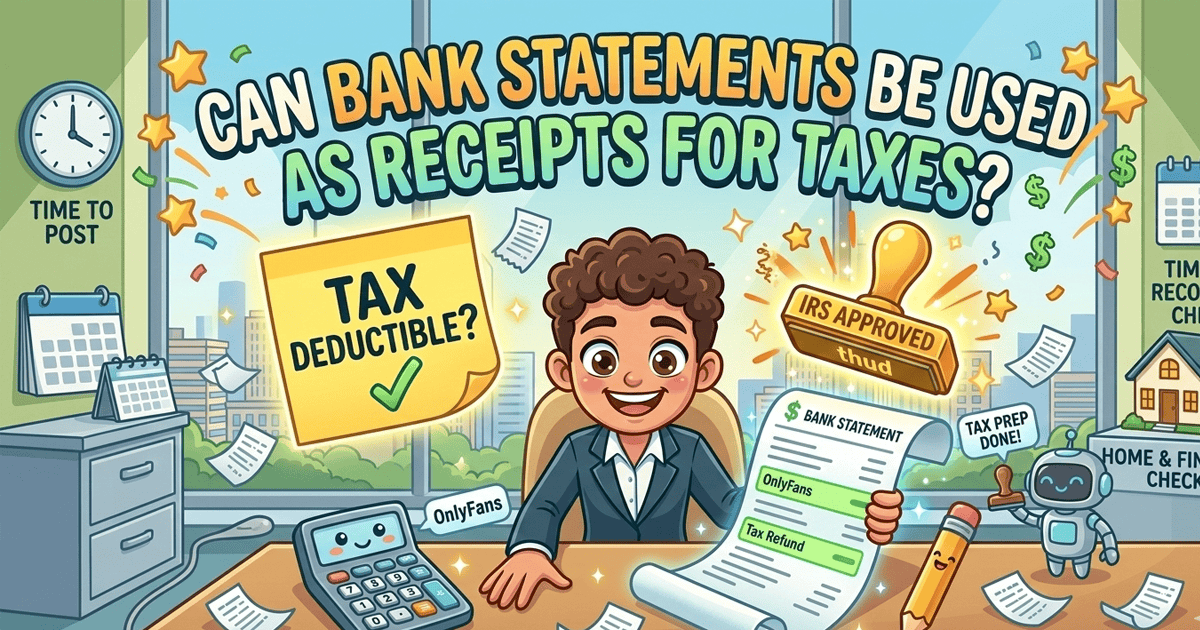
Using bank statements as tax receipts
Quick answer
  • Yes, for most small expenses: Under $75, bank statements are generally accepted by the IRS
  • Yes, for charitable donations under $250: Bank statement showing org name and amount is sufficient
  • Yes, to reconstruct lost receipts: Statements are the standard fallback if originals are gone
  • No, for meals over $75: IRS requires an itemized receipt plus business purpose documentation
  • No, for lodging: Hotel receipts required regardless of amount

The short answer is: it depends on the expense type and amount. Bank statements are valid tax documentation in many situations — and they're your best friend when you've lost receipts. But the IRS draws a hard line on certain categories where original receipts are non-negotiable.

In this guide
  1. What the IRS actually says about receipts
  2. When bank statements ARE accepted
  3. When bank statements are NOT enough
  4. How to reconstruct expenses from bank statements
  5. How long to keep bank statements for taxes

1. What the IRS Actually Says About Receipts

The IRS requires you to maintain "adequate records" to support every deduction. But "adequate records" doesn't always mean original receipts. Per IRS Publication 463 and Revenue Procedure 92-71, acceptable documentation includes:

  • Account statements (bank or credit card) that show amount, date, and payee
  • Cancelled checks
  • Invoices or bills marked paid
  • Original receipts (cash register tapes, itemized restaurant receipts)

The key rule: the documentation must clearly establish the amount, date, place, and business purpose of the expense. A bank statement covers the first three. The business purpose is on you to document separately.

The $75 threshold: For business expenses under $75, the IRS does not require a receipt at all (except for lodging). A bank statement entry is more than enough.

2. When Bank Statements ARE Accepted

Small business expenses under $75
The IRS does not require receipts for business expenses under $75 (except lodging). A bank statement showing the date, amount, and payee is usually sufficient.
Charitable cash donations under $250
For donations under $250, a bank statement or credit card statement showing the organization's name and amount is acceptable proof.
Reconstructed records (lost receipts)
If you lost your receipts, bank statements are the primary reconstruction tool. Courts have allowed deductions based on bank statements when the expense type was clear from the payee name.
Bank fees and interest
Bank-related deductions (mortgage interest, investment account fees) are documented entirely from bank and brokerage statements — no separate receipt needed.
Subscription and software expenses
Recurring business software charges from identifiable vendors (Adobe, Slack, AWS) shown on statements are generally accepted when the business purpose is obvious.

3. When Bank Statements Are NOT Enough

Meals and entertainment over $75
The IRS requires receipts AND a written record of the business purpose for meals. A bank statement showing 'RESTAURANT XYZ $142' is not enough — you need the itemized receipt.
Vehicle expenses (actual cost method)
You need repair receipts and gas receipts, not just bank statement entries, to document the actual cost method for vehicle deductions.
Travel lodging
Hotel receipts are explicitly required regardless of amount. A bank statement entry is not a substitute.
Cash purchases
If you paid cash, there is no bank statement record at all. You need the original receipt or a contemporaneous written record.
Home office expenses
While bank statements can show utility payments, you still need to document the square footage calculation and prove exclusive business use of the space.

4. How to Reconstruct Expenses from Bank Statements

If you've lost receipts, your bank statements are the starting point. Here's the process tax professionals recommend:

1
Download full statements for the tax year from your bank's website — every month, every account used for business.
2
Go through each transaction and flag business-related expenses. Use a spreadsheet or export to CSV.
3
For each flagged transaction, write a brief note about the business purpose: 'client lunch,' 'software for project X,' 'office supply run.'
4
Group expenses by category (meals, travel, supplies, subscriptions) to match Schedule C or your business expense categories.
5
For any significant expense where you can track down supporting documentation (email confirmations, calendar entries, project notes), attach those to your reconstruction.
6
If audited, present the reconstructed records with a statement explaining the original receipts were lost and describing your reconstruction method.
Tip: Upload your bank statement PDF to mybankstatementanalysis.com — it automatically categorizes every transaction into 19 spending categories and exports a clean CSV. That CSV becomes your reconstructed expense log, ready to hand to your accountant.

5. How Long to Keep Bank Statements for Taxes

SituationAudit windowHow long to keep statements
Standard return filed correctly3 years3–4 years after filing
Under-reported income by >25%6 years6–7 years after filing
Fraudulent returnNo limitPermanently
Property purchases / depreciation3 years after saleLife of property + 3 years
Employment tax records4 years4+ years

Most CPAs recommend a blanket 7-year rule for simplicity. Digital PDFs take up no space, so there's no reason not to keep them indefinitely.

Frequently asked questions

Can I use bank statements instead of receipts for taxes?+
For many expenses, yes — especially small amounts under $75 and charitable donations under $250. Bank statements are also the primary tool for reconstructing lost receipts. However, the IRS still requires original receipts for meals over $75, lodging, and some other categories regardless of the bank statement.
Will the IRS accept bank statements if I get audited?+
The IRS generally accepts bank statements as supporting documentation during an audit, especially combined with other records (invoices, contracts, emails). Courts have allowed deductions based on bank statements alone when the business purpose of the expense was clear. However, for meals and entertainment, the IRS requires both a receipt AND documentation of the business purpose.
How many years of bank statements should I keep for taxes?+
The IRS can audit returns for up to 3 years after filing. If you under-report income by more than 25%, the window extends to 6 years. For returns involving fraud, there is no time limit. Most CPAs recommend keeping bank statements for at least 7 years.
What if I lost my receipts before tax time?+
If you've lost receipts, bank and credit card statements are your best reconstruction tool. Go through your statements, identify business expenses, note the payee and amount, and document the business purpose. Attach a statement to your return explaining the reconstruction if the expense is significant.
Can bank statements prove charitable donations for taxes?+
Yes — for cash donations under $250, a bank statement or cancelled check showing the organization's name and the amount is sufficient IRS documentation. For donations of $250 or more, you need a written acknowledgment from the charity regardless of what your bank statement shows.
Does a credit card statement count the same as a bank statement for taxes?+
Yes. Credit card statements are treated the same as bank statements for tax documentation purposes. They show the date, amount, and merchant, which is generally sufficient for expenses under $75 and other categories where bank records are accepted.
Turn your bank statement into a tax-ready expense log

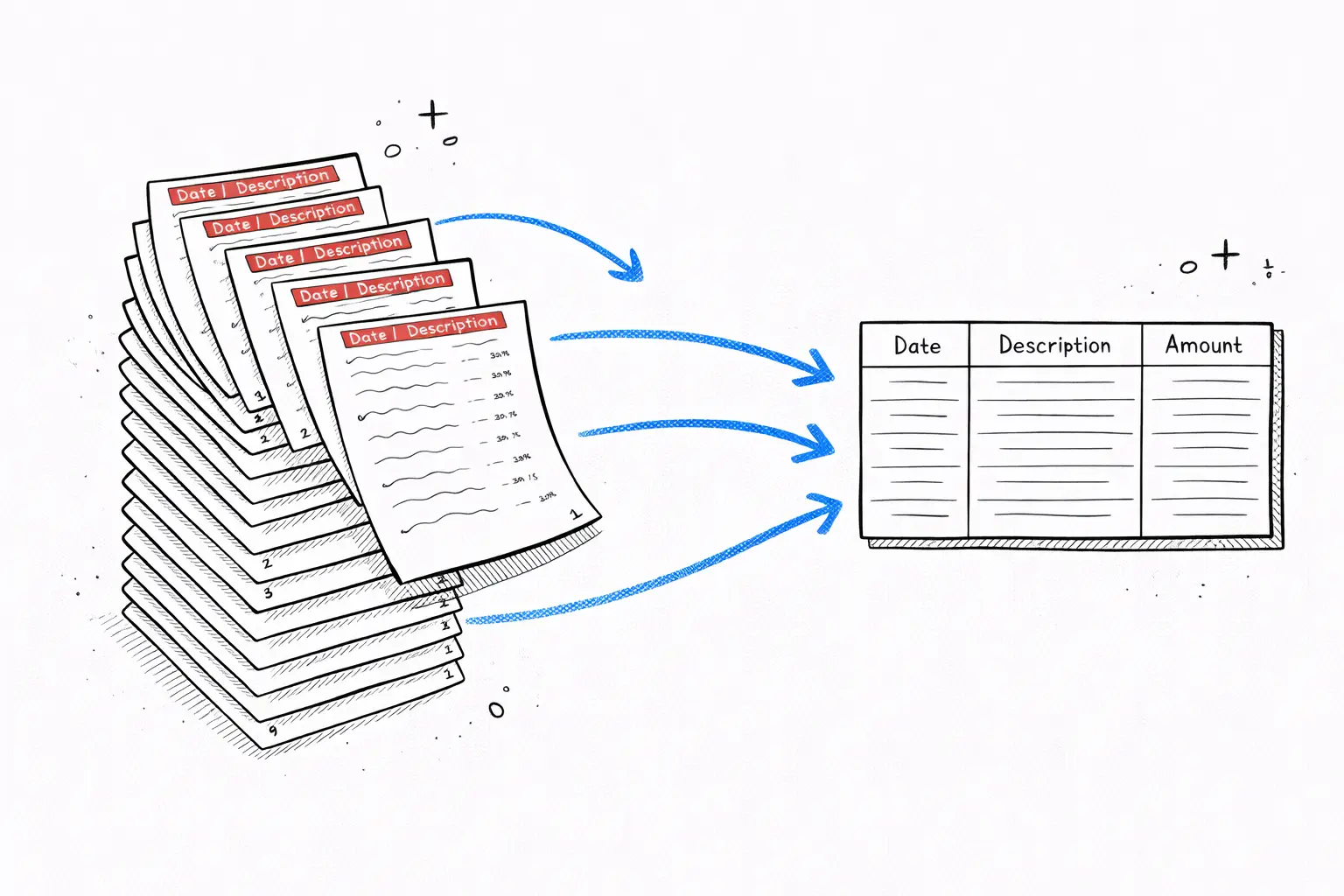
Upload your PDF and get every transaction automatically categorized — groceries, dining, business expenses, subscriptions. Export to CSV for your accountant in one click.
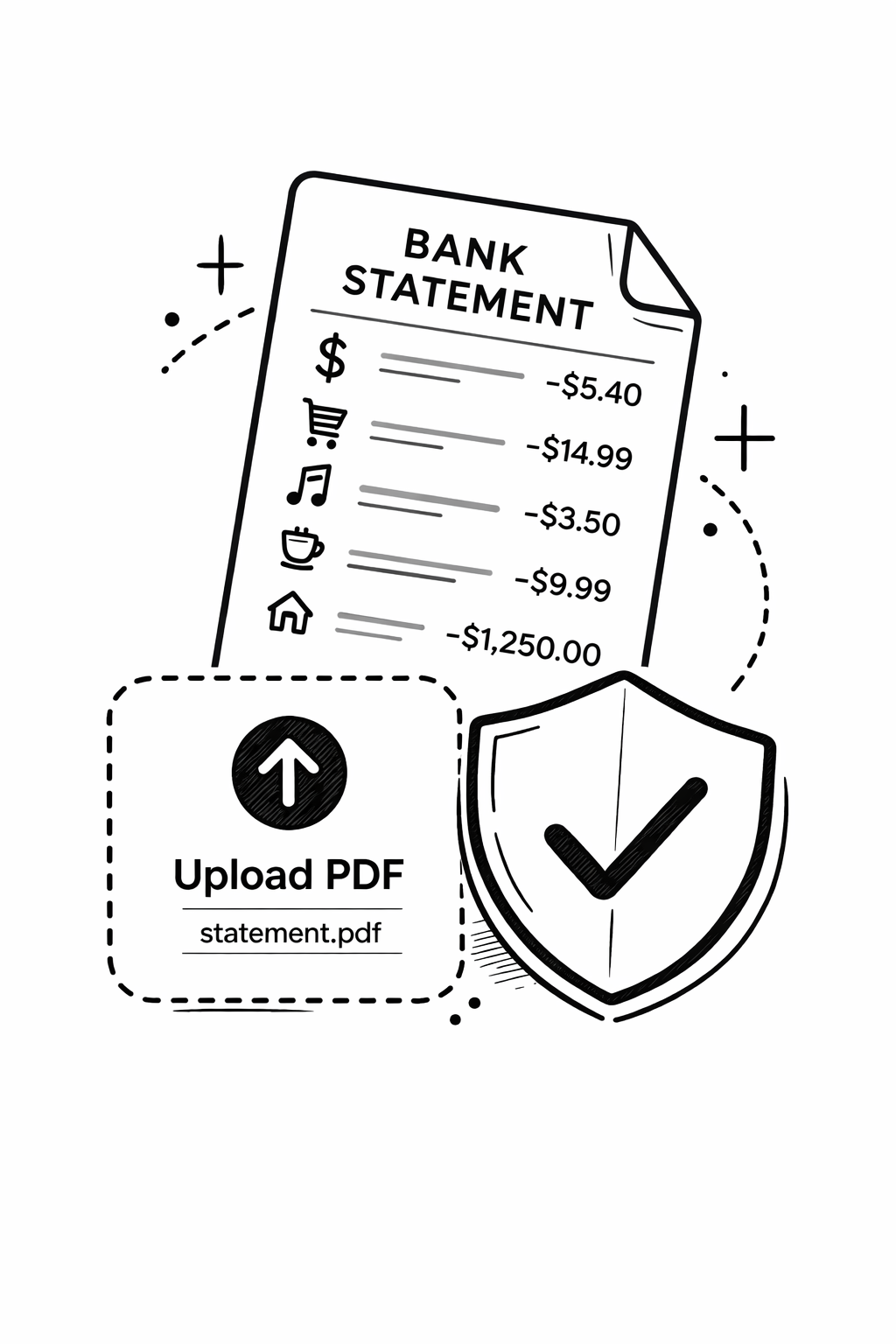
Analyze My Bank Statement Free →
No account required · 3 pages free
Continue reading
How to Paste CSV Into Excel (and Open CSV Files Properly)
Guide6 min read
How to Paste CSV Into Excel (and Open CSV Files Properly)
Every method for getting CSV data into Excel correctly — paste with Text to Columns, open files without losing formatting, and fix common import problems.
What Does YTD Mean on a Paycheck? Every Field Explained
Guide7 min read
What Does YTD Mean on a Paycheck? Every Field Explained
YTD stands for Year-to-Date. Here's what every YTD field on your pay stub means — gross pay, net pay, taxes, and deductions — with a real sample paycheck.
How to Do Bank Statement Analysis: The Complete Guide (2026)
Guide12 min read
How to Do Bank Statement Analysis: The Complete Guide (2026)
Step-by-step: from manual Excel methods to AI-powered tools that categorize everything in 30 seconds.