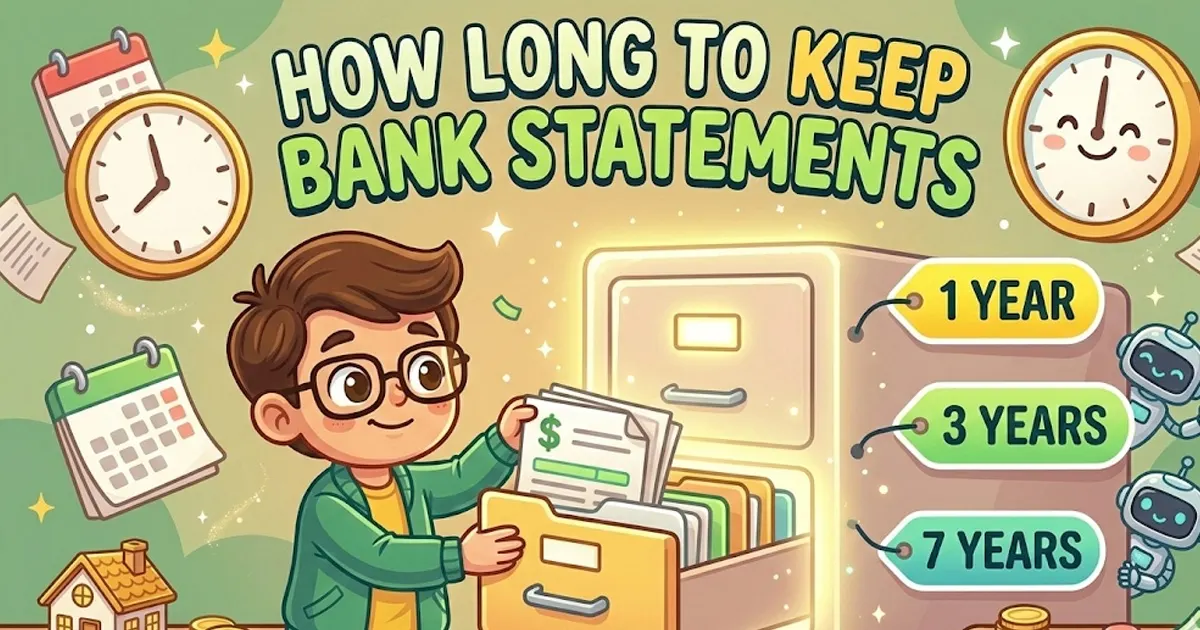
Most people either keep everything forever (cluttered) or throw statements away too soon (risky). The right answer depends on what the statements document. Here's the definitive guide.
1. The Retention Rules by Situation
General monthly statements
1 yearUseful for budgeting, subscription tracking, and resolving disputes. After 1 year, most issues have surfaced and been resolved.
Tax-related transactions
7 yearsThe IRS can audit returns up to 3 years back normally, 6 years if they suspect underreported income. Keep statements that document deductible expenses or income for at least 7 years to be safe.
Business / self-employment income
7 yearsAny statement showing business income or expenses needs to match your tax filings. IRS audits of self-employed individuals are more common — 7 years minimum.
Major purchases (car, electronics, appliances)
Until sold or replacedProof of purchase value matters for insurance claims, warranty disputes, and potential resale documentation.
Mortgage / home purchase
Forever (or until you sell)Statements showing your down payment, closing costs, and monthly payments are valuable documentation for capital gains calculations when you eventually sell.
Fraud / disputed transactions
Until fully resolved + 1 yearKeep all statements related to a fraud claim or dispute until the case is completely closed, then one additional year in case it resurfaces.
Digital statements
IndefinitelyStorage is free. If your bank provides digital statements, download and save them all — you never know when you'll need historical records.
2. What the IRS Actually Requires
The IRS doesn't specifically require you to keep bank statements — but they're the best supporting documentation for your tax return. Here's the practical breakdown:
Standard audit window
3 years from the filing date. This is when most audits happen. Keep statements for at least 3 years after filing.
Underreported income
If the IRS believes you underreported income by 25%+, they can go back 6 years. Self-employed individuals and freelancers should keep 7 years of records.
Fraud or no return filed
No time limit. If you never filed or are accused of fraud, the IRS can go back indefinitely. Always file, even if you can't pay.
Property / investments
Keep records related to property or investment purchases until you sell — and then 3 years after filing that return. A 2020 home purchase might need 2025 statements if you sell in 2022 and get audited in 2025.
Safe rule: Keep all bank statements for 7 years if any transactions on them relate to income, deductions, or business expenses. For purely personal non-tax statements, 1 year is fine.
3. Paper vs. Digital Statements
Paper statements
• Take up physical space
• Can be lost in fires, floods, moves
• Must be shredded before disposal
• Harder to search through quickly
• Some people prefer them for important docs
Digital statements
• Zero physical storage needed
• Searchable and easy to find
• Can be backed up to cloud
• Most banks offer 7+ years online
• Easy to share with accountants
Most banks retain digital statements for 5–7 years online. After that, they may be deleted. Don't rely solely on your bank to store your records— download and back up statements you'll need for tax purposes.
4. How to Safely Dispose of Old Statements
Bank statements contain sensitive information — account numbers, transaction history, your address. Never throw them in the recycling bin. Here's how to dispose of them safely:
1
Cross-cut shredder (best)
Shred paper statements with a cross-cut or micro-cut shredder — not a strip-cut shredder, which is easier to reassemble. $30–$60 shredders from any office supply store work well.
2
Shredding events
Many banks, libraries, and community centers host free shredding events. Check your local calendar — a practical way to eliminate years of old statements at once.
3
Delete digital files securely
Deleting a file doesn't remove it from your hard drive. Use a tool like Eraser (Windows) or Secure Empty Trash (Mac) for sensitive financial documents.
4
Never recycle unshredded
Identity thieves actively search recycling bins and dumpsters for financial documents. Even a statement from 5 years ago contains enough information to cause harm.
5. The Case for Keeping Everything Digitally
Digital storage is essentially free. A year of monthly bank statements as PDFs takes up roughly 1–5MB — you could store 50 years of statements in under 300MB, which fits on a $5 USB drive.
Given that, the practical advice is: download and keep all digital statements indefinitely. Back them up to two places (e.g., an external drive + Google Drive / iCloud). The risk of needing an old statement and not having it far outweighs the trivial cost of storage.
Pro tip: Use an AI bank statement analyzer on your older PDFs before archiving them. You'll get a spending summary for every year on record — useful for spotting long-term financial trends.
Try it free → Common questions
Do I need to keep bank statements for 7 years?
Only if they contain tax-related transactions — business income, deductible expenses, investment records. For everyday personal statements with no tax implications, 1 year is sufficient.
How long do banks keep your statements?
Most banks retain digital statements for 5–7 years, sometimes up to 10 years. After that, records may be purged. For statements you might need later (especially for tax purposes), download your own copies.
Can I request bank statements from years ago?
Usually yes, though older statements may incur a fee ($5–$25 per statement at many banks). Most banks retain records for at least 5 years and can provide copies upon request in branch or via customer service.
Do I need to keep bank statements if I have all my receipts?
Both serve different purposes. Receipts prove individual transactions; bank statements prove payment actually cleared and show the complete picture. For tax purposes, having both is stronger than either alone.