How to Split Finances with Your Partner: 3 Approaches That Work
Money is the number-one source of conflict in relationships — and it's usually not about how much you have, but how you manage it together. Should you combine everything? Keep it separate? Something in between? This guide walks through the three main approaches, how to pick the right one, and how to avoid the fights that derail even the strongest couples.
1. The 3 Approaches: Joint, Separate, Hybrid
Fully Joint
All income goes into one shared account. All bills, spending, and savings come from that account. Both partners have full visibility and access. This is the traditional "what's mine is yours" approach.
Fully Separate
Each partner maintains their own accounts. Shared expenses (rent, utilities, groceries) are split by agreement — either 50/50 or proportionally. Each person manages their own savings and personal spending independently.
Hybrid (Most Popular)
Both partners contribute to a joint account for shared expenses (rent, utilities, groceries, vacations). Each keeps a separate personal account for individual spending — hobbies, gifts for each other, personal subscriptions. This combines transparency for shared costs with autonomy for personal purchases.
2. Pros and Cons of Each Approach
| Approach | Pros | Cons | Best for |
|---|---|---|---|
| Fully Joint | Maximum transparency, simplest to manage, builds trust | No personal financial autonomy, can create tension over individual purchases | Married couples with similar spending habits |
| Fully Separate | Total autonomy, no arguments over personal spending | Less transparency, complex bill splitting, can feel disconnected | Early-stage relationships, couples with very different spending styles |
| Hybrid | Shared costs are transparent, personal spending is private, flexible | Requires more accounts to manage, need agreement on contribution amounts | Most couples, especially with different incomes |
3. How to Start the Money Conversation
The money conversation feels awkward because most people were taught that discussing finances is rude. But in a relationship, financial opacity causes more damage than any awkward conversation ever could.
When to have the conversation
Ideally before moving in together. At minimum, before combining any accounts or making joint financial commitments. If you're already sharing finances without having had the conversation, do it now — it's never too late.
What to cover
- Income. Both partners share their take-home pay. No shame, no judgment — just facts.
- Debt. Student loans, credit cards, car loans, medical debt. Knowing the full picture prevents surprises later.
- Spending habits. What does each person value spending on? What feels wasteful? There are no wrong answers here — just differences to understand.
- Financial goals. Where do you want to be in 1 year? 5 years? 10 years? Home ownership, travel, retirement, kids — align on the big ones.
- Money history. How did each of you grow up around money? Scarcity? Abundance? Secrecy? This context explains a lot of current behavior.
How to make it comfortable
- Schedule it — don't ambush your partner after a long day
- Use "I" statements: "I feel stressed about..." not "You spend too much on..."
- Come with data, not feelings — upload both bank statements and look at the numbers together
- Frame it as a team activity: "us vs the problem," not "me vs you"
- Keep it under 30 minutes for the first conversation — you don't need to solve everything in one sitting
4. Splitting Bills Fairly: Proportional vs 50/50
The question of "fair" is where most couples get stuck. Is 50/50 fair? Or should the higher earner pay more? Here are the two main approaches:
50/50 Split
Both partners pay exactly half of all shared expenses. Simple, equal, and easy to calculate. Works best when incomes are similar (within 20% of each other).
The problem: If one partner earns $8,000/month and the other earns $3,500, a 50/50 split on $3,000 rent means the lower earner spends 43% of income on rent while the higher earner spends just 19%. Equal isn't always equitable.
Proportional Split
Each partner contributes the same percentage of their income. If shared expenses are $4,000/month and combined income is $11,500:
| Partner | Income | Share of income | Contribution | % of income |
|---|---|---|---|---|
| Partner A | $8,000 | 70% | $2,800 | 35% |
| Partner B | $3,500 | 30% | $1,200 | 34% |
Both partners spend roughly the same percentage of their income on shared expenses. Both have a proportionally similar amount left for personal spending and savings. This feels fairer when there's a significant income gap.
5. Managing Different Income Levels
Income disparity is one of the trickiest areas in couple finances. Here are principles that work regardless of the gap:
Agree on a lifestyle level
The higher earner often wants a nicer apartment, fancier dinners, or better vacations. The lower earner may feel pressured to spend beyond their means to keep up. Solution: agree on a shared lifestyle level that the lower earner is comfortable with. The higher earner can upgrade personal expenses (nicer clothes, hobbies) with their own money.
Give both partners equal personal spending
In a committed partnership, giving both people the same personal spending allowance (regardless of who earned more) can reduce resentment. If the higher earner gets $600/month for personal spending and the lower earner gets $200, the imbalance creates a power dynamic.
Plan for income changes
Incomes shift over time — career changes, parental leave, illness, promotions. Build a system that can flex with these changes. Proportional splitting adapts automatically. A rigid 50/50 split breaks when one income drops.
6. Common Money Fights and How to Avoid Them
The Bottom Line
There is no universally right way to split finances. What matters is that both partners agree on the approach, communicate openly, and review the plan regularly. The best system is the one you both feel good about.
Start with an honest conversation. Look at the numbers together. Pick an approach. And schedule a monthly check-in to make sure it's working. Money doesn't have to be a source of conflict — when managed well, it becomes a source of shared confidence.
See where each partner's money goes. AI categorizes every transaction so you can have the money conversation with facts, not feelings.
Analyze Our Spending Free →Free tool · 30 seconds · No signup
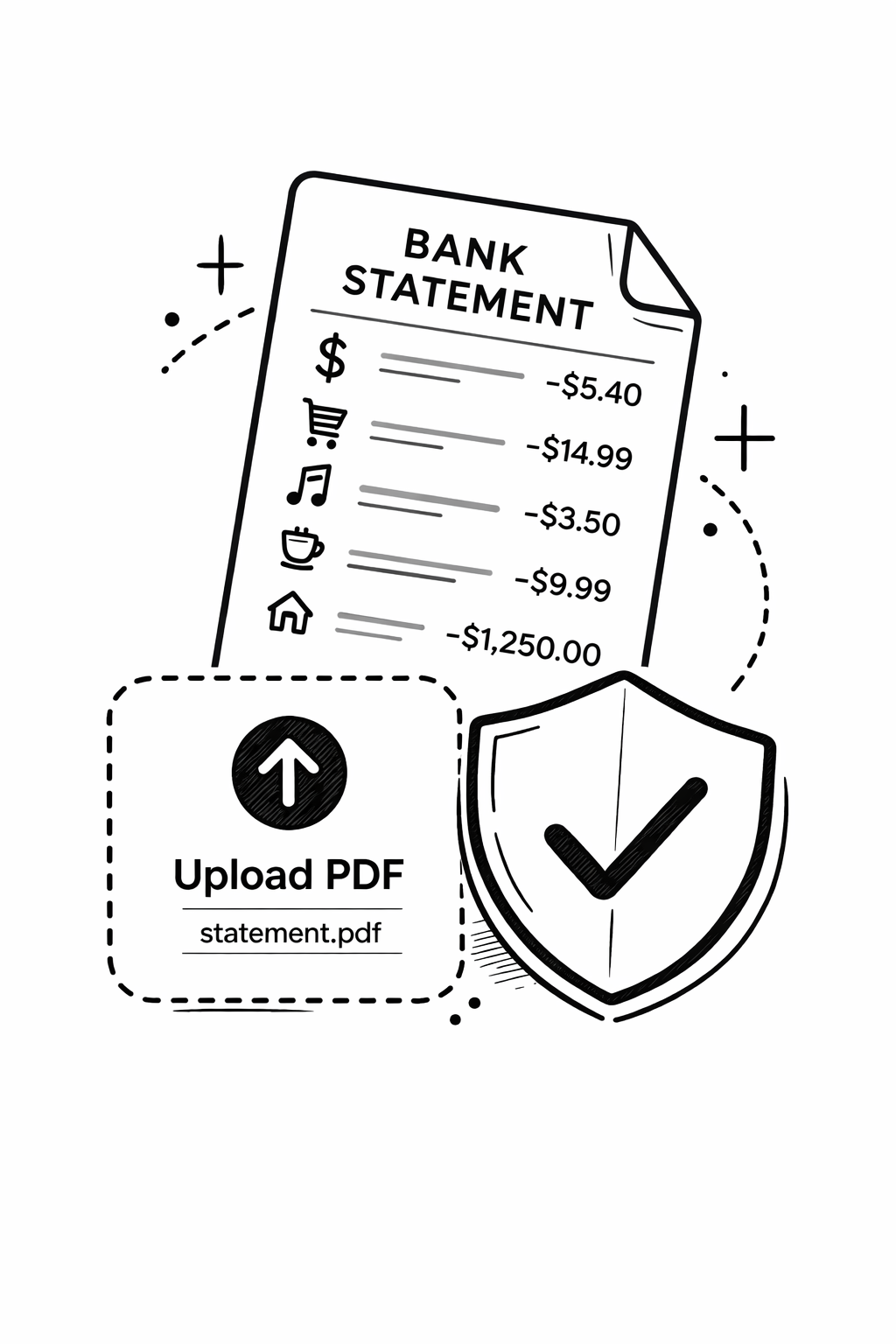
Upload a statement.
See where every dollar goes.
AI reads your bank PDF, categorizes every transaction, finds subscriptions you forgot about, and exports everything to CSV.
Frequently Asked Questions
Should couples have joint or separate bank accounts?
There is no single right answer. The best approach depends on your relationship, income levels, and personal preferences. Many couples use a hybrid system — a joint account for shared expenses and separate accounts for personal spending. The most important thing is that both partners agree on the system.
How do you split bills fairly when one partner earns more?
Proportional splitting is the most common fair approach. Each person contributes the same percentage of their income to shared expenses. If one earns $6,000/month and the other earns $4,000/month, the higher earner pays 60% of shared bills and the lower earner pays 40%.
When should couples start talking about money?
Before combining any finances — ideally before moving in together. At minimum, discuss income, debt, spending habits, and financial goals before sharing rent or opening joint accounts. Regular money check-ins (monthly or quarterly) keep both partners aligned.
What is the biggest money fight couples have?
The most common fight is about discretionary spending — one partner perceives the other as spending too much on non-essentials. This is usually a communication problem, not a spending problem. Agreeing on personal spending allowances and reviewing bank statements together prevents most of these conflicts.
How do you budget as a couple with different incomes?
Start by calculating total household income, then list all shared expenses. Decide how to split those (50/50 or proportional). Allocate personal spending allowances for each partner. Review actual spending monthly by uploading both bank statements and comparing to the plan.