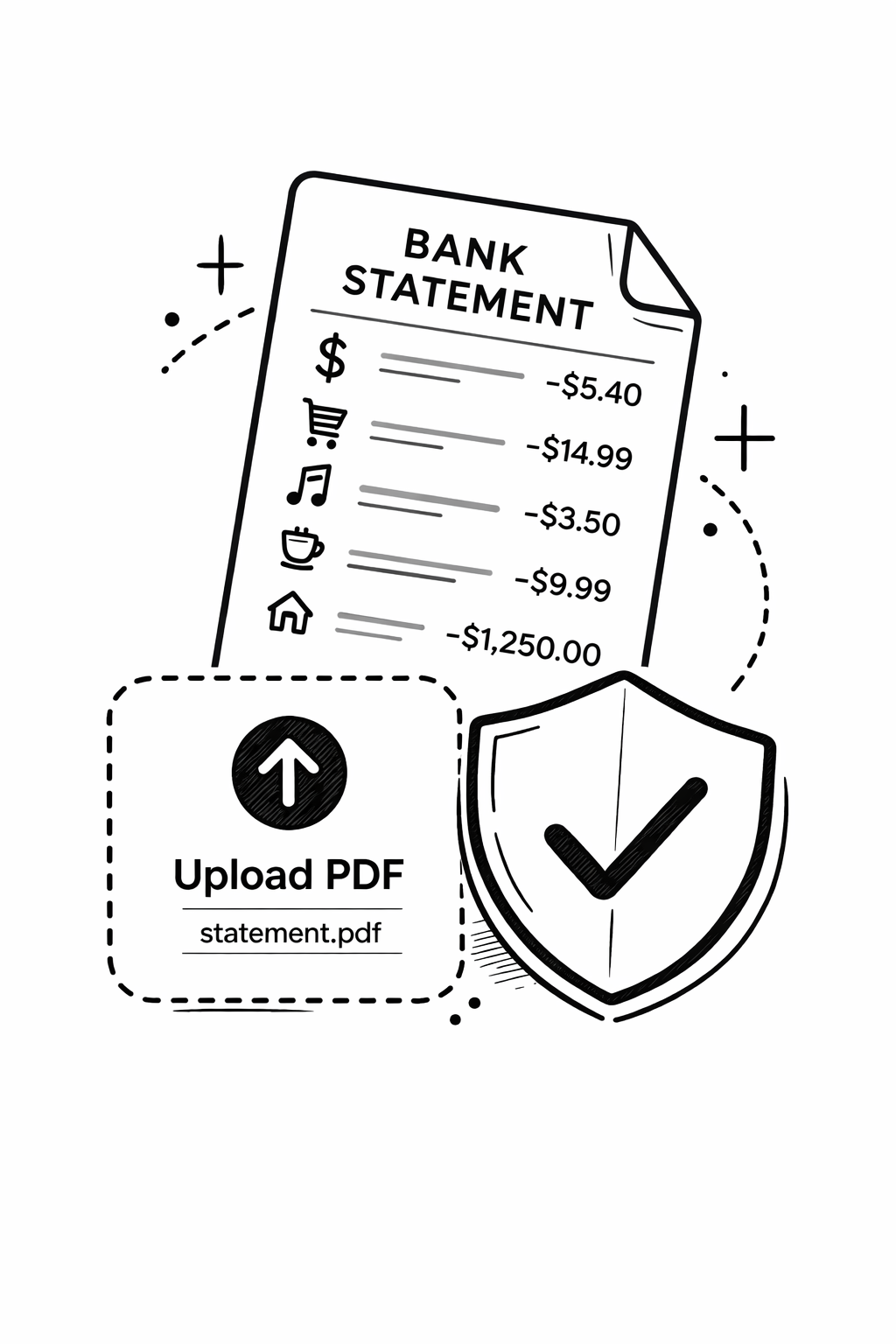
Analyze your statement
Upload a PDF to see categories, charts, subscriptions, and CSV export in one report.
No signup · deleted after analysis
Retirement Accounts
Bank statements for a 401(k): what shows up and when you need them
Your 401(k) and your bank account interact more than most people realise — but not always in the ways you expect. Here is exactly what appears on your bank statement related to 401(k) activity, and when a plan administrator will ask to see your statements.
Do 401(k) contributions show on your bank statement?
Not directly. Your 401(k) contributions are deducted from your gross paycheck by your employer before the net amount is deposited into your bank account. Your bank statement shows only the net payroll deposit — after your 401(k) contribution, taxes, health insurance premiums, and other deductions have been removed.
For example: if your gross bi-weekly paycheck is $4,000 and you contribute $400 (10%) to your 401(k), your bank statement will show a payroll deposit of approximately $2,700–$3,100 depending on your tax withholding and other deductions. The $400 401(k) contribution is not visible anywhere on the bank statement — it flows directly from payroll to your 401(k) plan.
To see your 401(k) contribution amount, check your pay stub or log into your plan administrator's portal (Fidelity, Vanguard, Empower, Schwab, etc.). Your Form W-2 (Box 12, Code D) shows your total 401(k) contributions for the year at tax time.
When 401(k) administrators ask for bank statements
Hardship withdrawal — proving financial need
This is the most common reason a 401(k) plan administrator will request bank statements. To qualify for a hardship withdrawal, you must demonstrate an immediate and heavy financial need. Bank statements showing the relevant expenses (medical payments, mortgage arrears, tuition payments) or the absence of other liquid assets provide the evidence the plan requires.
Rollover verification
For an indirect rollover (where the distribution cheque is sent to you rather than directly to the new plan), the receiving institution may ask for bank statements to confirm the funds were deposited within the 60-day rollover window. This protects you in the event of an IRS audit.
401(k) loan — bank account setup
When taking a 401(k) loan, the plan administrator needs your bank account details to deposit the loan proceeds. This is account verification, not a financial review — they are not assessing your creditworthiness from your statements. The loan repayment is typically handled via payroll deduction.
401(k) hardship withdrawals: what bank statement evidence is needed
The IRS defines a hardship as an immediate and heavy financial need that cannot be met from other resources. Qualifying reasons include:
Medical care expenses for you, your spouse, or dependents
Purchase of a primary residence (down payment — not mortgage payments)
Post-secondary tuition and related fees for the next 12 months
Payments necessary to prevent eviction or foreclosure on your primary residence
Funeral or burial expenses
Repair of damage to your primary residence (qualifying casualty losses)
Bank statements serve as supporting evidence for most of these categories. If you are claiming you cannot pay your mortgage, the administrator may want to see your bank statements confirming you lack the liquid funds. If you are claiming medical expenses, they want to see the payments leaving your account.
The plan's own Summary Plan Description (SPD) defines exactly what documentation is required — hardship withdrawal requirements vary by plan. Contact your HR department or plan administrator for the specific document checklist before applying.
401(k) loans: how they appear on bank statements
Loan proceeds
When a 401(k) loan is approved, the funds are deposited into your linked bank account as an incoming transfer. Your statement will show a deposit from your plan administrator or employer's payroll system. Unlike a hardship withdrawal, 401(k) loan proceeds are not taxed as income and do not incur a 10% penalty — they are a loan you repay from your own contributions.
Loan repayments
401(k) loan repayments are typically deducted from your paycheck via payroll deduction — the same mechanism as your original contributions. They do not appear as separate debits on your bank statement. You will see the net payroll deposit reduced by the repayment amount. If you leave your employer, some plans require full repayment or the outstanding balance becomes a taxable distribution.
Loan limits
The IRS limits 401(k) loans to 50% of your vested account balance or $50,000, whichever is less. Unlike hardship withdrawals, loans are repaid to your own account with interest — the interest you pay goes back to yourself.
What to look for on your bank statement if you contribute to a 401(k)
Your net payroll deposit
This is your take-home pay after all deductions — including your 401(k) contribution. The figure should match the net pay line on your pay stub. If your take-home pay is lower than expected, compare your latest pay stub to confirm the deduction amounts are correct.
Any 401(k) loan proceeds
If you have taken a 401(k) loan, confirm the deposit amount matches the approved loan amount. Keep this statement as evidence of the deposit date, which may be relevant for tax purposes.
Hardship withdrawal deposits
The net amount after 20% federal tax withholding. Retain this statement alongside your Form 1099-R for tax filing. The two figures should reconcile: the 1099-R gross distribution minus 20% withholding should equal the bank statement deposit amount.
Rollover deposits (indirect rollover only)
If you received a rollover cheque and deposited it, retain the bank statement showing the deposit date. The deposit must occur within 60 days of the original distribution date to qualify as a tax-free rollover. Missing this window results in the full amount being treated as taxable income.
Free tool · 30 seconds · No signup
See how your 401(k) contributions affect your cash flow
Upload your bank statement and get every deposit and deduction categorized — including payroll deposits, contributions, and recurring payments. Free, no account needed.
Common questions
Do 401(k) contributions show on my bank statement?
Indirectly, yes. Your 401(k) contributions are deducted from your paycheck before it is deposited — so your bank statement shows the net payroll deposit (after the 401(k) contribution has been removed). If you contribute $500 per paycheck to your 401(k) and your gross pay is $4,000, your bank statement will show a deposit of approximately $3,500 (minus taxes and other deductions). The contribution itself does not appear as a separate line item on your bank statement — it is handled entirely within your payroll and appears on your pay stub, not your bank statement.
What shows on a bank statement for a 401(k) hardship withdrawal?
When your hardship withdrawal is approved and disbursed, it appears on your bank statement as an incoming deposit from your 401(k) plan administrator or plan record-keeper (e.g., Fidelity, Vanguard, Empower). The description typically includes the plan name or administrator name. The amount shown is the net amount after the mandatory 20% federal tax withholding — so if you requested $10,000, you will see approximately $8,000 deposited (the withheld $2,000 goes directly to the IRS). Additional state tax may also be withheld.
How does a 401(k) rollover appear on a bank statement?
A direct rollover (plan to plan) does not appear on your bank statement at all — the funds move directly between the old 401(k) and the new plan or IRA without touching your bank account. An indirect rollover (where a cheque is issued to you) appears as a deposit on your bank statement from the old plan administrator. You then have 60 days to deposit it into a qualifying retirement account to avoid taxes and penalties. Banks typically describe it as an incoming wire or cheque deposit from the plan administrator.
Can I use bank statements to prove 401(k) contributions?
Bank statements are not the standard document for proving 401(k) contributions — your pay stubs and Form W-2 (Box 12, code D) are the primary records. However, bank statements can support a hardship withdrawal claim by showing the financial need that qualifies you — for example, medical bills paid from your account, mortgage arrears, or the absence of other assets. The 401(k) administrator will typically ask for bank statements as supporting evidence of hardship, not as contribution records.
What is the tax implication of a 401(k) withdrawal and does it show on my bank statement?
Any 401(k) withdrawal (other than a qualified Roth withdrawal or loan) is subject to federal income tax. Hardship withdrawals before age 59½ also carry a 10% early withdrawal penalty in most cases. Your bank statement only shows the net deposit — it does not show the tax withheld or the penalty. You will receive a Form 1099-R from your plan administrator at the end of the tax year, which shows the gross distribution, the taxable amount, and the federal income tax withheld.
How long should I keep bank statements related to my 401(k)?
Keep bank statements that document 401(k) activity — hardship withdrawal deposits, rollover receipts, loan repayment records — for at least seven years after the tax year in which the transaction occurred. The IRS generally has three years to audit a return, but six years if it believes income was significantly understated. Keeping records for seven years covers both scenarios with a margin. For rollover transactions in particular, retain records indefinitely to prove basis if you roll over Roth contributions.