What Is a Bank Statement?

Use the retrieval guide if your question is how to download, request, or print the actual statement PDF.
Get a bank statementCompare real bank statement layouts if you want to see what the document looks like in practice.
Open statement explorerUse the sample page if you need non-editable reference files rather than a definition or explanation.
Go to sample PDFsUse the analysis guide if your next question is how to review income, spending, red flags, and monthly patterns.
Analyze bank statementsQuick answer
Reviewed against current consumer-banking guidance and live bank statement materials. Exact labels and layout vary by institution, but the core document structure and statement frequency rules are consistent across the sources below.
If you have ever applied for a rental, checked your monthly spending, downloaded a PDF from online banking, or tried to verify an unknown charge, you have already used a bank statement. This page explains what a bank statement is, what it includes, and what people actually use it for.
1. What a bank statement is
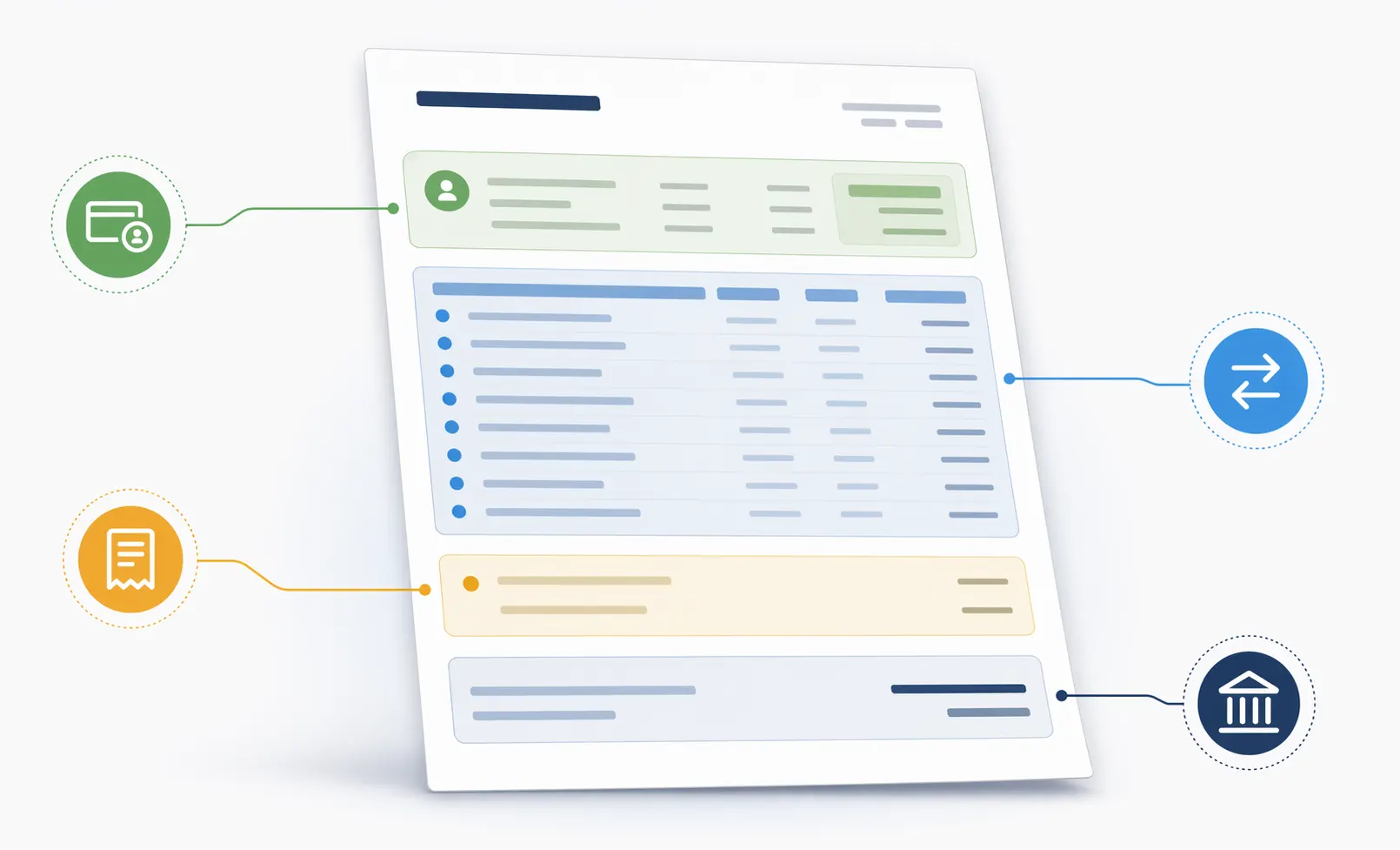
A bank statement is an official record created by your bank for a specific date range, usually one month. It captures the state of your account at the beginning and end of that period and lists every posted transaction in between.
In practical terms, it is the document you use when you want a stable, official snapshot of your account rather than a live activity feed. That is why landlords, lenders, accountants, courts, and visa officers often ask for statements instead of screenshots or account summaries.
2. What information a bank statement includes
| Part of the statement | What it shows | Why it matters |
|---|---|---|
| Statement period | The exact start and end dates covered by the document | Tells you what month or period the balances and transactions belong to |
| Account details | Your name, address, account type, and masked account number | Confirms whose account it is and which account the statement belongs to |
| Opening balance | How much money was in the account at the start of the period | Acts as the baseline for the month |
| Transaction list | Every posted deposit, withdrawal, transfer, payment, fee, and refund | This is the detail most people actually inspect |
| Money in / money out summary | Total credits and total debits for the period | Gives a fast snapshot of cash flow |
| Closing balance | How much money was in the account at the end of the period | Used for verification, reconciliation, and financial review |
3. What bank statements are used for
If you spot an unfamiliar entry on your statement, our unknown charge explainer can help you identify what it is before calling your bank.
4. Bank statement vs transaction history vs e-statement
| Term | What it means | When to use it |
|---|---|---|
| Bank statement | The official period-based document issued by the bank | Proof, review, taxes, reconciliation, and formal document requests |
| Transaction history | A live feed of account activity inside online banking | Checking recent activity day to day |
| E-statement | A digital version of a bank statement, usually as a PDF | Same use as a bank statement, just delivered online instead of by mail |
If you want the official document, you want the bank statement or e-statement PDF, not just the account activity view.
5. How to get a bank statement
Most people get a bank statement by logging into online banking or their bank's mobile app, opening the statements section, and downloading the PDF for the month they need.
For the full step-by-step version, use our guide on how to get a bank statement.