Analyze your statement
Upload a PDF to see categories, charts, subscriptions, and CSV export in one report.
No signup · deleted after analysis
What Is Corp E Corp E Check on a Bank Statement?
You see "CORP E CHECK" or "CORP E CORP E CHECK" on your bank statement next to a deposit or charge. Here's exactly what it means, where it came from, and whether you need to worry.
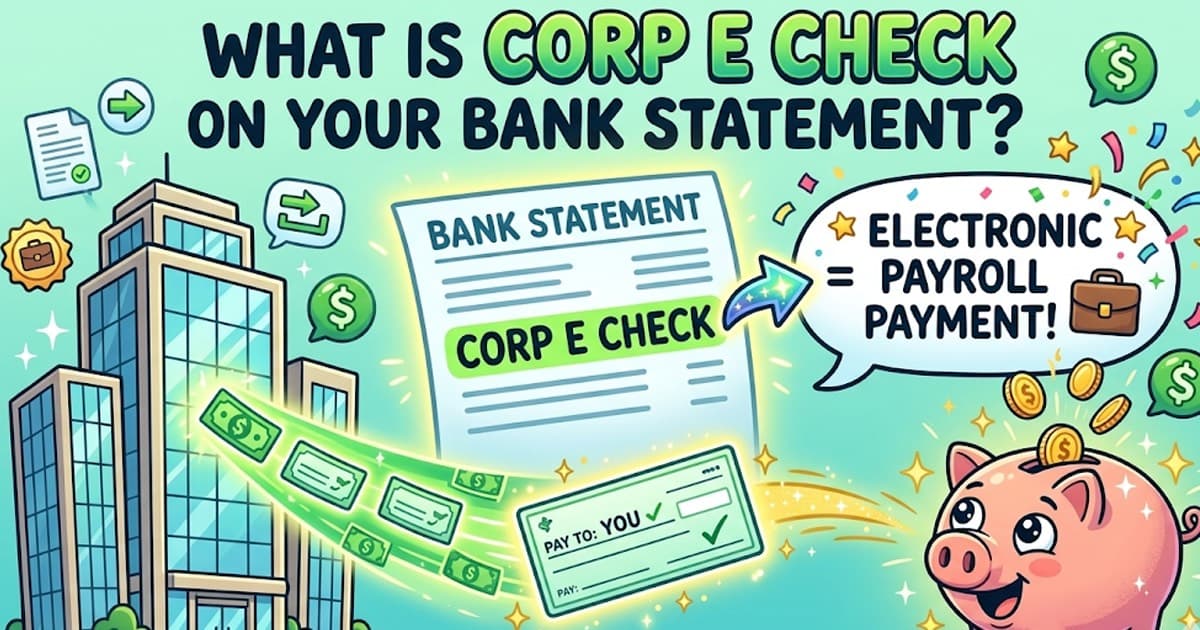
CORP E CHECK means Corporate Electronic Check. It's an ACH (Automated Clearing House) payment initiated by a company. "Corp" = corporate entity, "E" = electronic. Common sources include payroll direct deposits, insurance payouts, tax refunds, and vendor payments. If you see "CORP E CORP E CHECK" (doubled), it means the same thing — some banks just display the code twice.
What is a corporate electronic check?
A corporate electronic check is an ACH payment where a business sends or collects money electronically instead of writing a paper check. The ACH network — run by Nacha — processes billions of these transactions every year. When a company pays you via direct deposit, sends an insurance claim payment, or collects a monthly premium from your account, the transaction often shows up with a "CORP E" prefix.
The "E" stands for electronic, distinguishing it from a traditional paper check that gets scanned and deposited. Under the ACH system, corporate electronic payments use SEC (Standard Entry Class) codes like CCD (Corporate Credit or Debit) or CTX (Corporate Trade Exchange) — but your bank translates these into the human-readable "CORP E CHECK" label on your statement.
CORP E CHECK codes on bank statements
| Code on statement | What it means | Example |
|---|---|---|
| CORP E CHECK | A corporate electronic check — an ACH credit or debit initiated by a business | CORP E CHECK ACME CORP PAYROLL |
| CORP E CORP E CHECK | Same as CORP E CHECK — duplicated prefix is a formatting quirk by some banks | CORP E CORP E CHECK STATE FARM INS |
| ACH CORP E | An ACH transaction tagged as a corporate electronic payment | ACH CORP E IRS TREAS TAX REFUND |
| CORP ELECTRONIC | Shortened label for a corporate electronic check or ACH transfer | CORP ELECTRONIC BLUE CROSS CLAIMS |
| E CHECK | Generic electronic check — may be corporate or personal depending on the sender | E CHECK DEPOSIT ABC COMPANY |
| ACH CREDIT CORP | ACH credit from a corporation — typically payroll, refund, or insurance payout | ACH CREDIT CORP AMAZON VENDOR PMT |
Common sources of CORP E CHECK transactions
Most CORP E CHECK entries are routine payments from businesses and government agencies. Here are the most common sources:
- Payroll / direct deposit — your employer sends your salary via ACH, which shows as CORP E CHECK followed by the company name
- Insurance claim payouts — health, auto, home, or life insurance companies pay claims electronically (e.g., STATE FARM, BLUE CROSS)
- Tax refunds — IRS and state tax authorities send refunds via ACH, often labeled IRS TREAS or STATE TAX REFUND
- Vendor / contractor payments — businesses pay freelancers, suppliers, and contractors through corporate ACH transfers
- Pension and retirement benefits — pension funds, Social Security, and annuity providers use corporate electronic checks
- Dividend and investment distributions — brokerage firms and mutual funds distribute earnings via ACH
- Government benefits — unemployment, disability, and other government assistance payments
CORP E CHECK credits vs. debits
| Direction | What it means | Common examples |
|---|---|---|
| Credit (deposit) | Money coming INTO your account from a company | Payroll, tax refund, insurance payout, vendor payment, pension |
| Debit (withdrawal) | Money going OUT of your account, pulled by a company you authorized | Insurance premium, loan payment, subscription, utility bill, membership dues |
Credits are far more common than debits for CORP E CHECK entries. If you see a debit you don't recognize, check whether you signed up for automatic payments with any company — insurance premiums, gym memberships, and loan installments are common culprits.
What to do if you don't recognize a CORP E CHECK
Free tool · 30 seconds · No signup
Decode a CORP E-CHECK payment
Corporate electronic checks can hide the real payee. Paste the descriptor and AI tells you the likely source. Free, no signup.
Better fit for this topic