Analyze your statement
Upload a PDF to see categories, charts, subscriptions, and CSV export in one report.
No signup · deleted after analysis
What Is FDMS Payment on a Bank Statement?
You spot a charge labeled "FDMS" or "FDMS PAYMENT" on your bank statement and have no idea what it is. Here's exactly what it means, who charged you, and what to do if you don't recognize it.
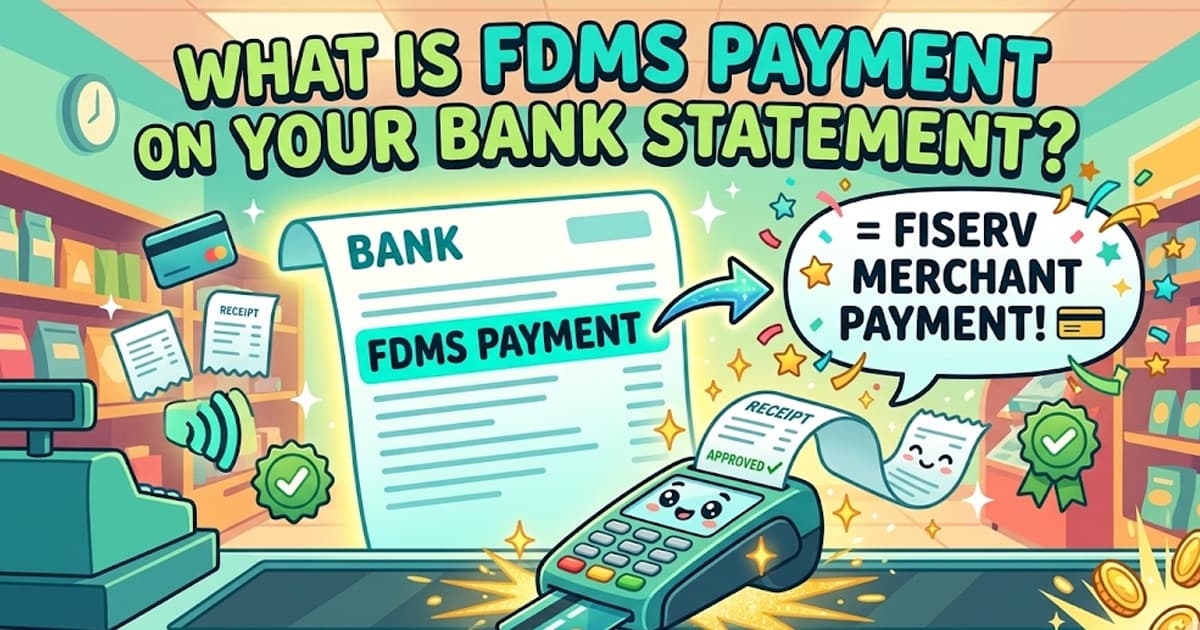
FDMS stands for First Data Merchant Services — one of the largest payment processors in the world, now part of Fiserv. When FDMS appears on your statement, it means you made a card purchase at a merchant (gas station, restaurant, retail store, etc.) that uses First Data to process payments. The charge came from the merchant, not from First Data itself.
What is First Data Merchant Services?
First Data Merchant Services (FDMS) is a payment processing company that enables businesses to accept credit and debit card payments. Founded in 1971, First Data grew to become one of the largest payment processors globally, handling billions of transactions per year for millions of merchants.
In 2019, First Data merged with Fiserv in a $22 billion deal. The combined company now operates under the Fiserv brand, but many merchants still process transactions through systems that carry the legacy FDMS name. That's why you might see "FDMS," "FIRST DATA," or "FISERV" on your bank statement — they all refer to the same payment processor.
First Data doesn't sell anything to consumers directly. They provide the technology and infrastructure that allows a gas station, restaurant, or retail store to swipe your card and receive payment. When FDMS shows up on your statement, it means a merchant used their system to process your purchase.
FDMS codes on bank statements — what each one means
| Code on statement | What it means | Example |
|---|---|---|
| FDMS | A card payment processed through First Data Merchant Services | FDMS SUNOCO 04821 |
| FDMS PAYMENT | Generic First Data processed transaction — debit or credit card purchase | FDMS PAYMENT PIZZA HUT |
| FIRST DATA | Same processor, full company name shown instead of abbreviation | FIRST DATA CORP 7293841 |
| FISERV | Parent company name (First Data merged with Fiserv in 2019) | FISERV MERCHANT SVC |
| FDMS POS | Point-of-sale transaction processed through First Data at a physical terminal | FDMS POS SHELL OIL 00321 |
| FD MERCHANT | Shortened form of First Data Merchant — same processor, different label | FD MERCHANT SVC 48291 |
Why does FDMS appear instead of the merchant name?
When you pay with a card, the transaction passes through several systems before it reaches your bank. Sometimes the processor name (FDMS) gets displayed instead of the actual store name. Here are the most common reasons:
- The merchant didn't configure their business name properly in the payment terminal — so the processor name defaults
- Your bank's system prioritizes the processor identifier over the merchant name in the transaction record
- Small or independently owned businesses (gas stations, local restaurants) are more likely to show processor names
- The transaction is still pending or settling — the merchant name may appear once it fully clears
- Franchise locations sometimes process under a corporate or regional entity name rather than the storefront name
Where do FDMS charges typically come from?
First Data / Fiserv processes payments for millions of merchants across every industry. However, certain types of businesses are especially likely to show the FDMS name on your statement:
- Gas stations — independent stations and chains like Shell, Sunoco, BP, and Chevron frequently use First Data terminals
- Restaurants — both chains and local restaurants, especially those using Clover POS systems (owned by Fiserv)
- Retail stores — clothing shops, hardware stores, convenience stores, and specialty retailers
- Grocery stores — regional grocery chains and independent markets
- Hotels and lodging — many hospitality businesses use First Data for front-desk and room charge processing
- Medical offices — doctor's offices, dentists, and clinics that accept card payments
What to do if you don't recognize an FDMS charge
Paste the exact text from your statement into our tools — they cover thousands of merchant codes, processor labels, and subscription billing names.
Free tool · 30 seconds · No signup
Decode an FDMS payment
FDMS is First Data's processor — many merchants run through it. Paste the descriptor and AI identifies the likely business. Free, no signup.
Better fit for this topic