Analyze your bank statement

Upload PDF → see categorized spending, charts, subscriptions, and export to CSV. Free, 30 sec.

AI categorization
Spending charts
CSV & Excel export
Private & encrypted
Upload your PDF free →

No signup · deleted after analysis

← Back to blog
Reference

POS Debit vs POS Purchase vs POS Credit

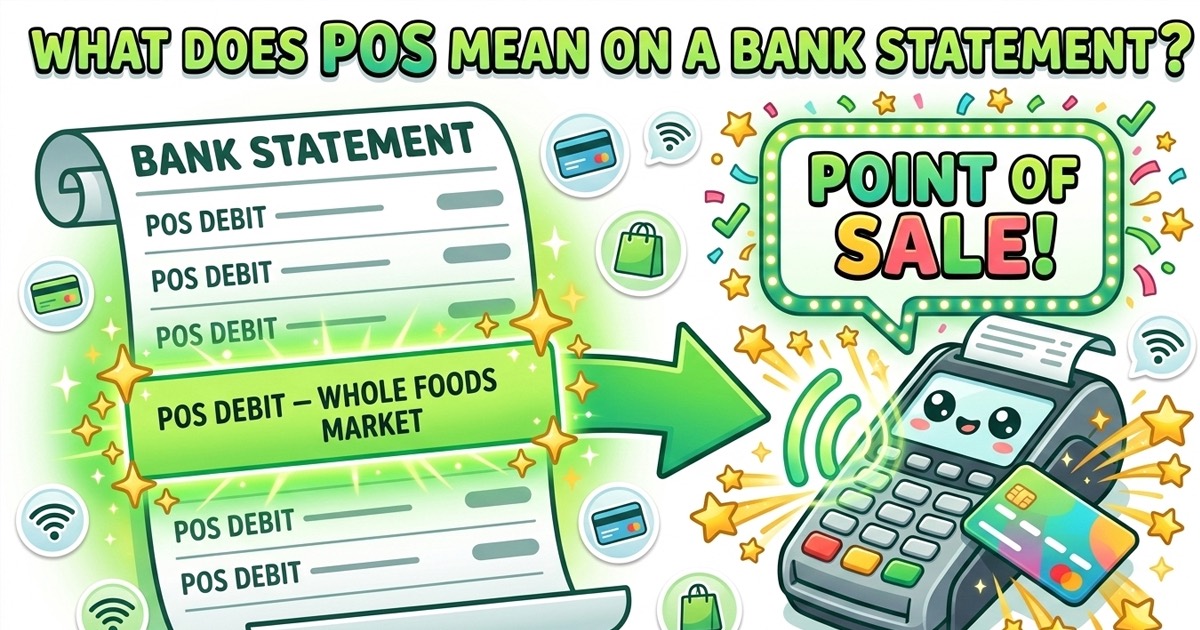
POS DEBIT and POS PURCHASE mean the same thing — a debit card purchase at a store or terminal. The only difference is which label your bank uses. POS CREDIT is the opposite: money returned to your account, usually after a refund.

May 4, 2026 · 5 min read
POS Debit vs POS Purchase vs POS Credit
Quick answer

POS DEBIT = POS PURCHASE. Both indicate a debit card purchase at a physical store terminal. The label varies by bank — Chase uses POS DEBIT, Wells Fargo uses POS PURCHASE. POS CREDIT means a refund or reversal was applied to your debit card, increasing your balance.

What each POS code means

CodeWhat it meansWhen it appearsExample
POS DEBITA debit card purchase at a physical store or terminal. Funds leave your account immediately or within one business day.Any in-person debit card swipe, tap, or chip purchasePOS DEBIT TARGET 00012345
POS PURCHASEFunctionally identical to POS DEBIT — just the label some banks use instead. Also a debit card purchase at a point-of-sale terminal.Same as POS DEBIT; label depends on your bankPOS PURCHASE WALMART #4821
POS CREDITA credit back to your account from a POS source — usually a refund, merchant correction, or partial void after a return.After you return an item or receive a refund to your debit cardPOS CREDIT AMAZON.COM
POS REFUNDSame as POS CREDIT — money returned to your debit card by a merchant after a return.Merchant return processed to your debit cardPOS REFUND HOME DEPOT

How major banks label POS transactions

Every bank records the same underlying transaction, but the label on your statement depends entirely on the institution. Here is what the six largest US banks typically show:

BankDebit labelPurchase labelCredit / Refund labelNotes
ChasePOS DEBITPOS PURCHASEPOS REFUND / POS CREDITChase uses both 'POS DEBIT' and 'POS PURCHASE' interchangeably. Refunds show as 'POS REFUND'.
Bank of AmericaCHECKCARD / POS PURCHASEPOS PURCHASEPOS RETURNBofA prefers 'CHECKCARD' for most debit transactions; PIN-routed purchases may show 'POS PURCHASE'.
Wells FargoPURCHASE AUTHORIZED POS DEBITPOS PURCHASEPOS RETURNWells Fargo prepends 'PURCHASE AUTHORIZED ON [date]' before the POS label.
Capital OneDEBIT CARD PURCHASEDEBIT CARD PURCHASEPOS CREDITCapital One often omits the 'POS' prefix entirely and uses 'DEBIT CARD PURCHASE'.
CitibankPOS DEBITDEBIT CARD PURCHASEPOS CREDITCiti uses both formats depending on the account type and processing network.
US BankELECTRONIC POS TRANSPOS PURCHASEPOS CREDITUS Bank uses 'ELECTRONIC POS TRANS' for some PIN debits routed through ATM networks.

What is POS CREDIT and why did you receive it?

A POS CREDIT is a deposit back to your checking account that originated from a point-of-sale merchant. The most common reasons:

POS CREDIT entries usually appear within 3–5 business days of the return or refund request. If you see one you don't recognize, check your email for refund confirmations or search the merchant name paired with the date.

What to do if you don't recognize a POS charge

1
Check the date and amount
Cross-reference with your receipts or purchase memory. A $4.75 POS charge on a Tuesday morning is probably your coffee, even if the name looks unfamiliar.
2
Google the merchant name
Copy the exact text after 'POS DEBIT' or 'POS PURCHASE' and search it. Most mystery charges resolve in 30 seconds — the business just operates under a different legal name.
3
Check with family members
If you share a debit card or account, another cardholder may have made the purchase.
4
Call the merchant directly
If you recognize a business but the amount seems wrong, call them with the date and amount. They can look up the transaction on their end.
5
Dispute with your bank
If you genuinely don't recognize the charge and believe it's fraud, contact your bank immediately. Under Regulation E, you have 60 days from the statement date to dispute unauthorized debit card transactions.
Want the full POS guide?

See every POS code explained — POS HOLD, POS AUTH, POS SETTLEMENT, POS REFUND, ATM POS, and more.

Full POS guide →

Free tool · 30 seconds · No signup

Upload a statement.
See where every dollar goes.

AI reads your bank PDF, categorizes every transaction, finds subscriptions you forgot about, and exports everything to CSV.
Frequently asked questions

What is the difference between POS DEBIT and POS PURCHASE?
There is no functional difference. Both mean a debit card purchase at a physical point-of-sale terminal. Different banks use different labels — Chase often uses 'POS DEBIT,' while Wells Fargo and others use 'POS PURCHASE.' The result is identical: funds are deducted from your checking account.
What does POS CREDIT mean on a bank statement?
POS CREDIT means money was credited back to your account from a point-of-sale source. This is usually a refund after you returned an item, a merchant correction, or a partial void. Unlike POS DEBIT or POS PURCHASE, which reduce your balance, POS CREDIT increases it.
Is POS DEBIT the same as a regular debit?
Yes. POS DEBIT is simply a debit card purchase made at a physical merchant terminal — a store, gas station, restaurant, or any place with a card reader. The 'POS' prefix just tells you it was an in-person transaction rather than an online purchase, ACH transfer, or ATM withdrawal.
Why does my statement show POS DEBIT instead of the store name?
The POS prefix appears before the merchant name. For example: 'POS DEBIT STARBUCKS #2847.' The store name is still there — it's just after the POS DEBIT label. If the merchant name looks unfamiliar, it may be a parent company or payment processor name. Search the exact text online to verify.
What does POS DEBIT mean on a Chase statement?
On Chase statements, 'POS DEBIT' indicates a debit card purchase at a physical store or terminal. Chase typically shows the date and location after the label. Chase also uses 'POS PURCHASE' for some transactions — both mean the same thing.
Can POS CREDIT appear without me making a return?
Occasionally, yes. A merchant may issue a partial correction, price adjustment, or tip refund without a full return. If you see a POS CREDIT you don't recognize, check your email for refund notifications or contact the merchant with the date and amount.
What is a POS refund vs POS credit?
They are functionally identical — both add money back to your account. Some banks use 'POS REFUND' (Chase, Wells Fargo), while others use 'POS CREDIT' (US Bank, Capital One). In all cases, the money came from a merchant reversing all or part of a previous charge.
I see a POS DEBIT I don't recognize — is it fraud?
Not necessarily. First, check the date and amount against your receipts. Then search the merchant name online — many businesses bill under a different legal name. If you still can't identify it after 48 hours, contact your bank. Under Regulation E, you have 60 days from the statement date to dispute unauthorized debit card transactions.
Decoding every line on your statement by hand is slow. A bank statement analyzer reads the whole PDF in 30 seconds and labels every merchant automatically.
Other mystery charges explained
Amazon chargesApple.com/billNetflix / 121 Albright WaySP SpotifyUber / Uber EatsGoogle / 1600 AmphitheatreMSFT (Microsoft)POS chargesComenity PayTPG ProductsWMT Plus (Walmart)SQ (Square)
Continue readingView all posts →
Reference6 min read
What Is a POS Hold on a Debit Card? Meaning, Duration & How to Remove (2026)
A POS hold reserves funds on your debit card after a purchase. Learn why gas stations, hotels and restaurants place holds, how long they last, and what to do if a hold won't drop off.
Reference4 min read
What Is a Counter Deposit on a Bank Statement? — 2026
Counter deposit = money deposited at a bank teller's counter — cash, check, or money order handed to a bank employee at the branch. How it differs from counter credit, ATM, and mobile deposits, and what triggers it.
Reference6 min read
What Does Overdraft Mean on a Bank Statement? (2026 Guide)
An overdraft on your bank statement means you spent more than your available balance and the bank covered the difference — usually with a $30–$36 fee. See every overdraft code, why you got charged, and how to get the fee refunded.