Analyze your statement
Upload a PDF to see categories, charts, subscriptions, and CSV export in one report.
No signup · deleted after analysis
What Does POD Mean on a Bank Statement?
You see "POD" next to your account name or in the account details section and wonder if it means a payment was made. It doesn't. Here's exactly what it means and why it matters.
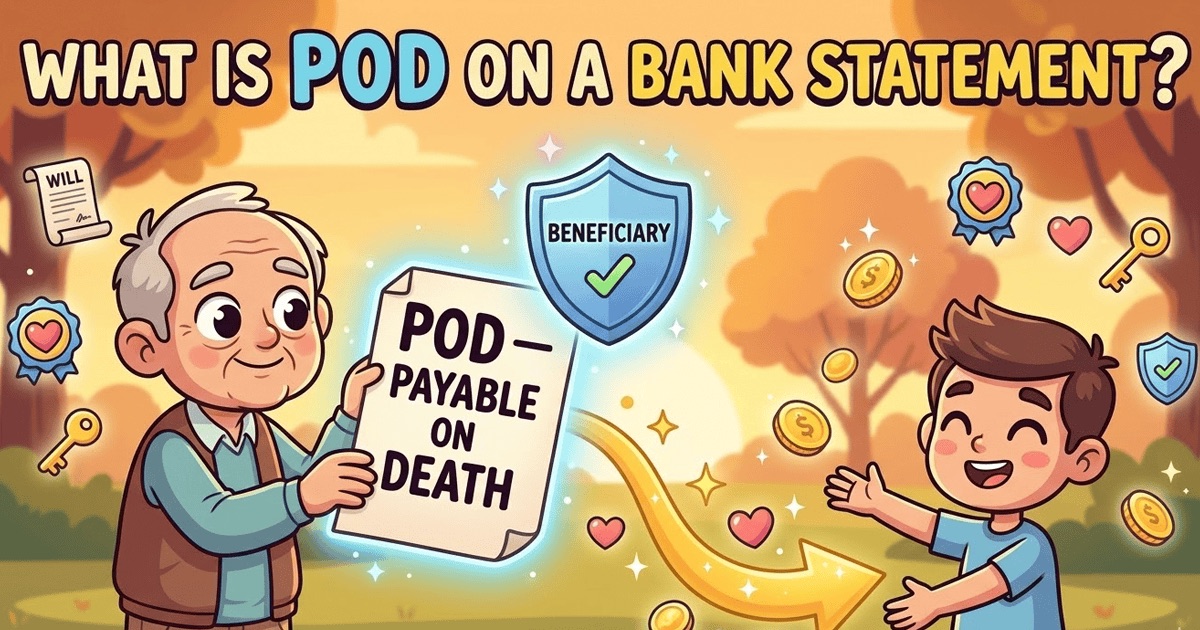
POD stands for Payable on Death. It is a beneficiary designation on the account — not a transaction or a charge. It means you have named someone to receive the account funds automatically when you die, without going through probate. No money has moved. The designation only activates upon death.
POD is an account designation, not a transaction
The most common confusion: people see "POD" on a statement and assume money went somewhere. It didn't. POD appears in the account header or account details section — not in the transaction list — because it describes the account itself, not an activity on it.
Think of it as a label on the account: "This account has a death beneficiary on file." The named beneficiary has no access and no impact on the account until the moment of the account holder's death.
POD and its variants — what each means
Different banks and account types use slightly different abbreviations for the same concept:
| Abbreviation | Full meaning | How it appears |
|---|---|---|
| POD | Payable on Death — generic designation used by most banks | Checking account: POD to Jane Smith |
| TOD | Transfer on Death — same as POD, used more often for investment/brokerage accounts | TOD: John Smith (son) |
| ITF | In Trust For — older equivalent of POD, now rarely used but still appears on legacy accounts | ITF John Doe |
| ATF | As Trustee For — another legacy variant, functions identically to POD | ATF Mary Jones |
| BENEFICIARY | Some banks spell it out fully rather than using the acronym | Beneficiary: Robert Smith |
How a POD account works — step by step
POD vs. a will — how they compare
Many people assume their will controls everything. For accounts with a POD designation, the will is irrelevant. The POD designation wins — always.
| Aspect | POD designation | Will |
|---|---|---|
| Speed of transfer | Days — bank processes directly | Months — probate court required |
| Legal process | None — bank handles it | Court supervised probate |
| Privacy | Private — not public record | Public record once filed in probate |
| Can be contested | Very difficult | Easier to challenge in court |
| Covers | Only the specific bank account | All assets named in the document |
| Cost to set up | Free — bank form | Attorney fees ($300–$2,000+) |
| Overrides the other? | POD overrides the will for that account | Will does not override POD designation |
Divorce, remarriage, the birth of a child, or the death of a beneficiary — none of these automatically update your POD designation. Your bank will pay whoever is named on file, regardless of your current relationships or what your will says. Review beneficiary designations annually.
Who can be named as a POD beneficiary?
Most banks allow you to name any of the following:
- An individual person (spouse, child, sibling, friend — any adult)
- Multiple people with specified percentage splits (e.g., 50% to each child)
- A trust — useful for minor children who cannot legally own an account
- A charity or nonprofit organization
- An estate (though this defeats the probate-avoidance purpose)
You cannot name a minor child directly without a trust or custodial arrangement — the court would appoint a guardian to manage the funds until the child reaches adulthood, which reintroduces the probate delays POD is designed to avoid.
What happens to a bank account without a POD?
If an account holder dies with no POD designation and no joint account holder, the account becomes part of their estate and goes through probate:
Free tool · 30 seconds · No signup
See a POD entry you don't recognize?
POD usually means 'payable on death' — but unusual descriptors deserve a check. Paste yours and AI tells you the likely source. Free, no signup.
Better fit for this topic