Analyze your bank statement

Upload PDF → see categorized spending, charts, subscriptions, and export to CSV. Free, 30 sec.

AI categorization
Spending charts
CSV & Excel export
Private & encrypted
Upload your PDF free →

No signup · deleted after analysis

← Back to blog
Reference

POS Transaction Meaning in Banking

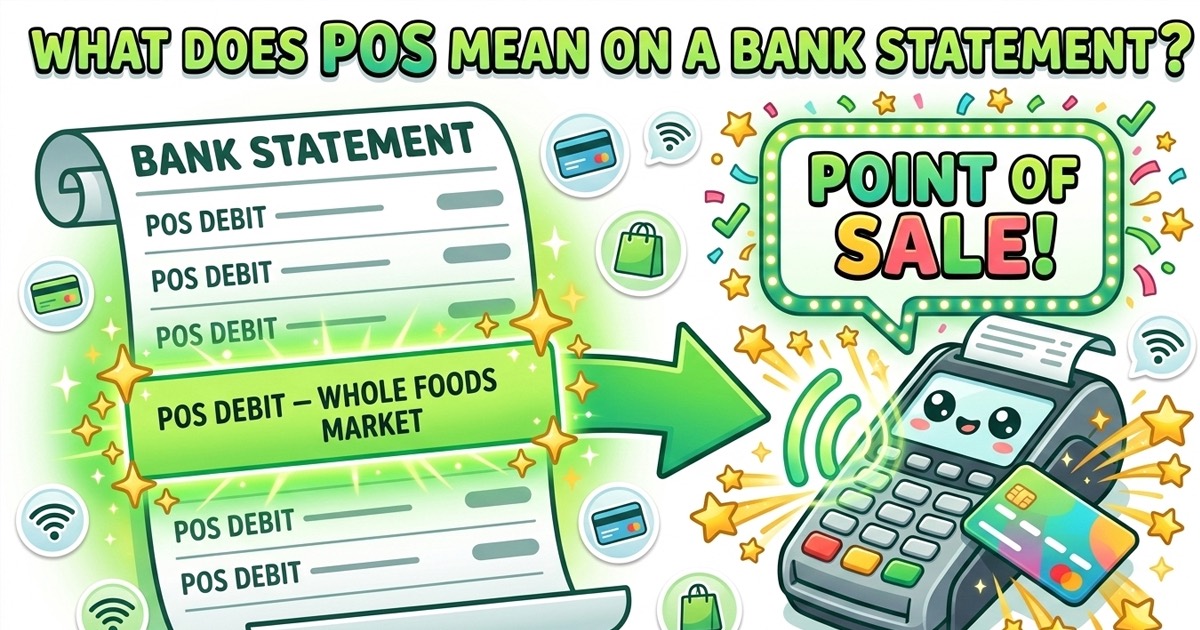
A POS transaction is a card purchase at a physical merchant terminal. "POS" stands for Point of Sale — the location where you swipe, tap, or insert your card. Every in-store purchase, gas station fill-up, and restaurant bill paid by card is a POS transaction.

May 4, 2026 · 7 min read
POS Transaction Meaning in Banking
Quick answer

A POS transaction (Point of Sale) is any purchase made by physically presenting a card at a merchant terminal. The full form is "Point of Sale." Common types include POS PURCHASE, POS DEBIT, POS AUTH, POS HOLD, POS SETTLEMENT, POS REFUND, and POS CREDIT. POS transactions differ from online purchases, ATM withdrawals, and ACH transfers in that they require physical card presence at a terminal.

POS transaction types explained

Banks use different labels to describe different stages and types of POS transactions. Here is every label you might see on a statement:

TypeWhat it meansExampleNetwork
POS PURCHASEStandard debit or credit card purchase at a physical terminalPOS PURCHASE WALMART #4821Visa, Mastercard, or PIN debit
POS DEBITSame as POS PURCHASE — just a different label used by some banksPOS DEBIT TARGET 00012345Visa, Mastercard, or PIN debit
POS AUTHPre-authorization hold — funds reserved but not yet chargedPOS AUTH SHELL OIL 00123Any debit network
POS HOLDActive reservation of funds for a pending transactionPOS HOLD UBER EATSAny debit network
POS SETTLEMENTFinal cleared charge replacing a prior AUTH or HOLDPOS SETTLEMENT SHELL OIL 00123Any debit network
POS REFUNDMerchant returned money to your debit card after a returnPOS REFUND HOME DEPOTSame as original purchase
POS CREDITCredit back to account — refund, correction, or partial voidPOS CREDIT AMAZON.COMSame as original purchase
POS WITHDRAWALCash back obtained during a purchase at a POS terminalPOS WITHDRAWAL WALGREENSPIN debit / ATM network
ATM POSPIN-based purchase routed through ATM networks like STAR or NYCEATM POS DEBIT 7-ELEVENSTAR, NYCE, PULSE
ELECTRONIC POS TRANSGeneric label some banks use for any electronic POS debitELECTRONIC POS TRANS CVSAny debit network
DOMESTIC POSPOS purchase inside your home countryDOMESTIC POS WHOLEFOODSAny domestic network
FPOSForeign POS — purchase outside your home country, often with FX feesFPOS LIDL BERLIN DEVisa / Mastercard international

POS vs other transaction types

Not every card transaction is a POS transaction. Here is how POS differs from the other common types:

Transaction typeWhat triggered itPIN required?Where it happens
POS transactionCard swipe, tap, or chip at physical terminalSometimesStore, gas station, restaurant, hotel
Online purchaseCard number entered on website or appNoE-commerce, subscription services
ATM withdrawalCash withdrawal at ATMYesATM machine
ACH transferBank-to-bank electronic transferNoBill pay, direct deposit, wire
Mobile walletPhone tap at terminal (Apple Pay, Google Pay)No (biometric instead)Any terminal with NFC

How POS transactions are processed

When you tap your card at a terminal, here is what happens behind the scenes in roughly 2–3 seconds:

1
Card data is read
The terminal reads your card's chip, magnetic stripe, or NFC signal (tap). It extracts the card number, expiry, and a one-time cryptogram.
2
Authorization request
The terminal sends an authorization request to the merchant's bank (acquirer), which forwards it to your bank (issuer) through the card network (Visa, Mastercard, etc.).
3
Bank verifies funds
Your bank checks that you have sufficient funds or credit, then sends an approval code back through the chain.
4
POS AUTH / POS HOLD
If approved, your bank places a temporary hold on the funds. Your available balance drops, but the money hasn't actually moved yet.
5
Settlement
At the end of the business day, the merchant submits all approved transactions for settlement. The holds are replaced by final charges, and money moves from your account to the merchant's account.

Why POS transaction amounts sometimes differ

It is common for the POS AUTH amount to differ from the final charge. Here is why:

Related POS guides

See detailed guides on specific POS codes and how they appear on your statement.

Full POS guide →POS DEBIT vs PURCHASE →POS HOLD guide →

Free tool · 30 seconds · No signup

Upload a statement.
See where every dollar goes.

AI reads your bank PDF, categorizes every transaction, finds subscriptions you forgot about, and exports everything to CSV.

Frequently asked questions

What is a POS transaction in banking?
A POS (Point of Sale) transaction is any purchase made by physically swiping, inserting, or tapping a payment card at a merchant's terminal. The terminal can be at a store checkout, gas pump, restaurant, hotel, or any device that accepts card payments. The funds are deducted from your checking account (debit) or added to your credit line (credit).
What is the full form of POS transaction?
The full form of POS is 'Point of Sale.' It refers to the physical location or device where a card transaction is completed. In banking, 'POS transaction' specifically means a card payment made at a merchant terminal rather than online, via ATM, or through a bank transfer.
What is the difference between a POS transaction and an online purchase?
A POS transaction happens in person at a physical terminal — you physically present your card. An online purchase happens remotely — you enter your card number on a website or app. POS transactions usually show 'POS' on your statement; online purchases typically show the merchant name without a POS prefix.
What does 'transaction type POS' mean on my statement?
'Transaction type POS' means the transaction was categorized by your bank as a Point of Sale purchase. This label appears in online banking apps and CSV exports to distinguish POS purchases from ATM withdrawals, ACH transfers, checks, and online transactions.
Can a POS transaction be a credit card purchase?
Yes. POS transactions can be made with debit cards, credit cards, or prepaid cards. Credit card POS purchases are functionally identical — you tap or swipe at a terminal — but the money is borrowed from your credit line instead of deducted from your checking account. Credit card statements often omit the 'POS' prefix and show only the merchant name.
What is an electronic POS transaction?
'Electronic POS trans' is a generic label some banks (notably US Bank) use for any electronically processed POS debit. It is functionally identical to 'POS PURCHASE' or 'POS DEBIT' — the 'electronic' prefix simply emphasizes that the transaction was processed digitally rather than through a paper-based system.
What is a domestic POS vs FPOS?
'Domestic POS' means the purchase was made inside your home country. 'FPOS' (Foreign POS) means the purchase was made abroad. FPOS transactions often carry additional foreign transaction fees — typically 1–3% of the purchase amount — and may use a different exchange rate than domestic purchases.
Why do some POS transactions show a different merchant name?
The name on your statement comes from what the merchant registered with their payment processor, not their storefront sign. A local café might process under an LLC name, a gas station under the oil company's name, or a small business under their payment processor (Square, Toast, Stripe). If the amount matches a purchase you remember, the charge is almost certainly legitimate.
Decoding every line on your statement by hand is slow. A bank statement analyzer reads the whole PDF in 30 seconds and labels every merchant automatically.
Other mystery charges explained
Amazon chargesApple.com/billNetflix / 121 Albright WaySP SpotifyUber / Uber EatsGoogle / 1600 AmphitheatreMSFT (Microsoft)POS chargesComenity PayTPG ProductsWMT Plus (Walmart)SQ (Square)
Continue readingView all posts →
Reference6 min read
What Is a POS Hold on a Debit Card? Meaning, Duration & How to Remove (2026)
A POS hold reserves funds on your debit card after a purchase. Learn why gas stations, hotels and restaurants place holds, how long they last, and what to do if a hold won't drop off.
Reference4 min read
What Is a Counter Deposit on a Bank Statement? — 2026
Counter deposit = money deposited at a bank teller's counter — cash, check, or money order handed to a bank employee at the branch. How it differs from counter credit, ATM, and mobile deposits, and what triggers it.
Reference6 min read
What Does Overdraft Mean on a Bank Statement? (2026 Guide)
An overdraft on your bank statement means you spent more than your available balance and the bank covered the difference — usually with a $30–$36 fee. See every overdraft code, why you got charged, and how to get the fee refunded.