← Back to blogReference
What Is Counter Credit on a Bank Statement?
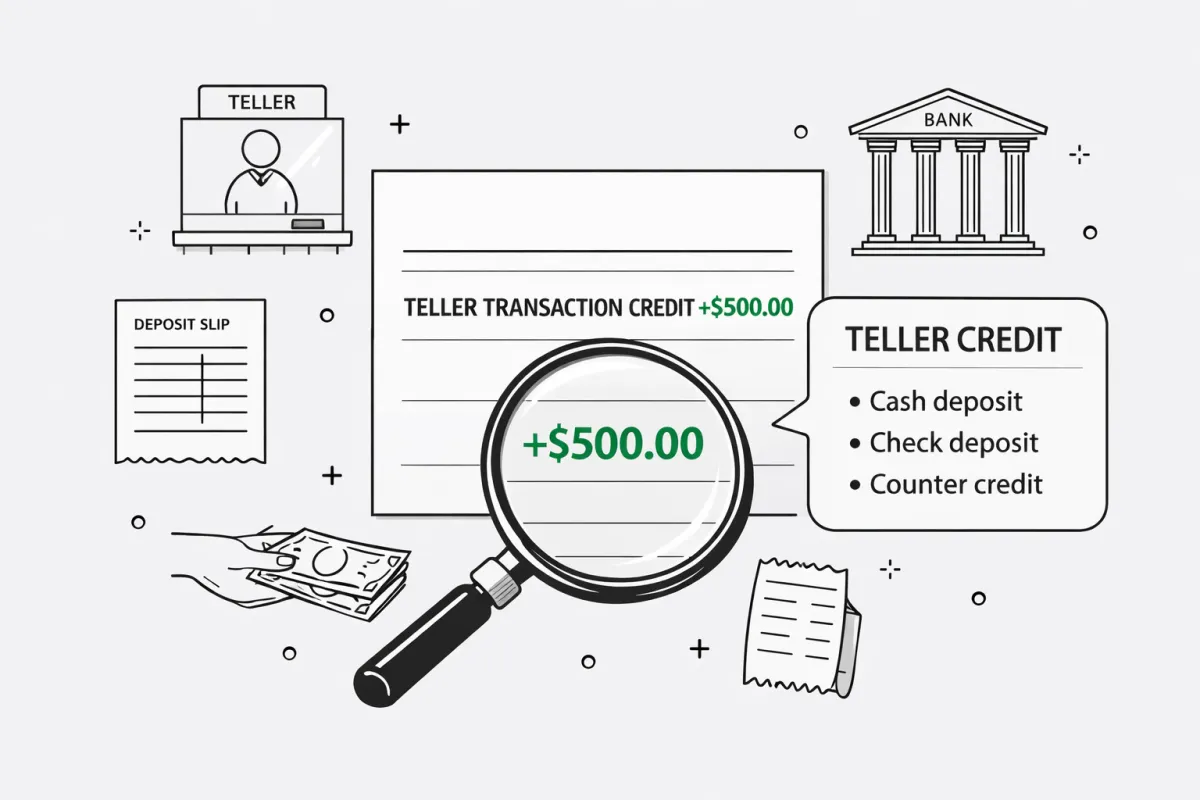
Counter credit means money was deposited in person at a bank teller window. The bank records cash or a check handed across the physical counter as a credit added to your account. "Counter" refers to the branch counter; "credit" means money in. The same transaction may also appear as "OTC deposit," "teller transaction credit," "branch deposit," or "in-branch credit."
March 9, 2026 · 3 min read

Quick answer
A counter credit is a deposit made in person at a bank teller window — "over the counter." It is usually cash or a check deposited at a branch, not an ATM deposit, mobile deposit, ACH credit, or direct deposit. The word "credit" means your balance went up.
What does counter credit mean?
In banking, a "counter" refers to the physical teller counter at a bank branch. A "credit" means money was added to your account. So a counter credit is literally a credit applied at the teller counter — an in-person deposit.
When you walk into a bank branch and hand a teller cash or a check to deposit, the transaction is recorded as a counter credit on your statement. The alternative labels you might see at different banks include:
- COUNTER CREDIT
- OTC DEPOSIT (over the counter)
- BRANCH DEPOSIT
- TELLER DEPOSIT
- IN-BRANCH CREDIT
These all mean the same thing. The terminology varies by bank — Chase and Wells Fargo use "counter credit," while Bank of America uses teller transaction credit. Credit unions often use "share deposit."
Counter credit vs. other deposit types
| Statement label | How it was made | Availability |
|---|
| COUNTER CREDIT | In person at a teller window | Same day or next business day |
| ATM DEPOSIT | Cash or check deposited at an ATM | Same day (cash) or 1–2 days (check hold) |
| MOBILE DEPOSIT | Check photographed via mobile app | 1–2 business days (holds common) |
| ACH CREDIT | Electronic transfer from another account or payer | 1–3 business days |
| DIRECT DEPOSIT | Employer payroll sent directly to account | Same day or 1 day early |
| WIRE TRANSFER | Bank-to-bank electronic wire | Same day (domestic) |
What it looks like on your statement
A counter credit entry on your bank statement typically looks like this:
DATEDESCRIPTIONAMOUNT
03/09/2026COUNTER CREDIT+$500.00
Some banks include more detail — a branch code, teller ID, or partial account reference. Others just show the date and amount.
When counter credits matter
In most everyday situations, a counter credit is unremarkable. But it becomes relevant in a few specific contexts:
Mortgage or loan applications
Lenders scrutinize large deposits. A $10,000 counter credit may trigger a request for you to document where the cash came from — a gift, a sale, savings withdrawn from another account, etc.
Tax purposes
Large cash deposits — especially multiple counter credits just under $10,000 — can attract IRS attention. Banks are required to file Currency Transaction Reports (CTRs) for cash deposits over $10,000.
Legal proceedings
In divorce or bankruptcy cases, counter credits are traced to verify the source of funds. Unexplained large deposits can raise questions.
Reconciling your bank statement?
Upload your bank PDF to our free analyzer and see every deposit, credit, and withdrawal categorized automatically — perfect for spotting mismatched counter credits.
Analyze my statement free →If you're reconciling your bank statement, make sure each counter credit matches a deposit slip or receipt from that branch visit. Counter credits are frequently flagged during reconciliation because the statement description often lacks detail — your own records are essential to confirm the source and amount.
Free tool · 30 seconds · No signup
Want every deposit labeled automatically?
Upload the full statement and AI separates counter credits, ACH deposits, direct deposits, transfers, fees, and spending in one report.
Better fit for this topic
Frequently asked questions
What does counter credit mean on a bank statement?
Counter credit means a deposit was made in person at a bank teller window — 'over the counter.' The bank records it as a credit (money added to your account) made at their physical counter. It typically includes the date and sometimes a branch code or teller ID.
Is a counter credit a good thing?
Yes — a counter credit simply means money was added to your account. There's nothing negative about the term itself. 'Credit' in banking always means your balance increased; 'debit' means it decreased.
What is the difference between a counter credit and a direct deposit?
A counter credit is a deposit you make yourself at a teller window — cash or a check handed to a bank employee. A direct deposit is an electronic transfer sent directly to your account by an employer or government agency. They both increase your balance, but the method and labeling are different.
How long does a counter credit take to clear?
Cash deposited as a counter credit is usually available immediately or by the end of the business day. Checks deposited over the counter may be subject to a hold — typically 1–2 business days for standard checks, or up to 5–7 days for large checks or accounts with a short history.
Why does my counter credit show a different amount than I deposited?
This can happen if the teller counted your cash and found a discrepancy, if part of the check deposit was placed on hold (only a portion released immediately), or if a fee was deducted. Check with your bank if the amount doesn't match your deposit receipt.
Can I dispute a counter credit on my statement?
If a counter credit is incorrect — for example, an amount was credited to your account by mistake — the bank can reverse it. You don't 'dispute' a credit the way you dispute a charge, but you should notify your bank immediately if you receive money that isn't yours. Banks are required to reverse erroneous credits.
What does 'OTC deposit' mean — is that the same as counter credit?
Yes. OTC stands for 'over the counter' — the same as a counter credit. Different banks use different labels for the same action: an in-person teller deposit. You may see COUNTER CREDIT, OTC DEPOSIT, BRANCH DEPOSIT, or TELLER DEPOSIT depending on your bank.
Decoding every line on your statement by hand is slow. A
bank statement analyzer reads the whole PDF in 30 seconds and labels every merchant automatically.
Other mystery charges explained
Reference4 min read
What Is a Counter Deposit on a Bank Statement? — 2026
Counter deposit = money deposited at a bank teller's counter — cash, check, or money order handed to a bank employee at the branch. How it differs from counter credit, ATM, and mobile deposits, and what triggers it.
→
Reference3 min read
Teller Transaction Credit on a Bank Statement (Bank of America) — 2026
Teller transaction credit = a deposit made in person at a bank teller (most common on Bank of America statements). What it looks like, how it differs from counter credit, and what to do if the amount seems wrong.
→
Guide4 min read
Teller Transaction Credit: What It Means on Your Bank Statement (BofA, Chase)
Teller transaction credit means an in-person deposit made at a teller window — cash or check, processed by a bank employee. See exactly what it looks like on Bank of America, Chase & Wells Fargo, and how long it takes to clear.
→