
Bank statement to QIF
Bank statement to QIF
Upload a PDF — get a QIF file ready to import into Quicken or QuickBooks Desktop .
Choose The Right Tool
Need all export formats?
Use the converter owner page when you want to compare CSV, Excel, QIF, OFX, and QBO instead of choosing QIF first.
Open the converter →Need QuickBooks Online import?
Use QBO if the destination is QuickBooks Online. QIF is the better fit for Quicken and QuickBooks Desktop.
Open QBO conversion →Need the modern Quicken format?
Use OFX when you want FITID duplicate detection and broader support across Quicken, GnuCash, and Moneydance.
Open OFX conversion →Output format
What the QIF file looks like
!Type:Bank
D10/15/2025
T-67.42
PWHOLEFDS MKT #10247
LGroceries
^
D10/15/2025
T-4.75
PSTARBUCKS #8291
LDining Out
^
D10/14/2025
T-1,850.00
PZELLE TO LANDLORD
LHousing
^
D10/14/2025
T2,847.63
PPAYROLL - ACME CORP
LIncome
^
D
Date
T
Amount
P
Payee
L
Category
^
End of transaction
How it works
Three steps to import into Quicken
Upload your bank statement PDF
Drop your PDF — digital or scanned. JPG and PNG images also work. Any bank worldwide.
AI extracts every transaction
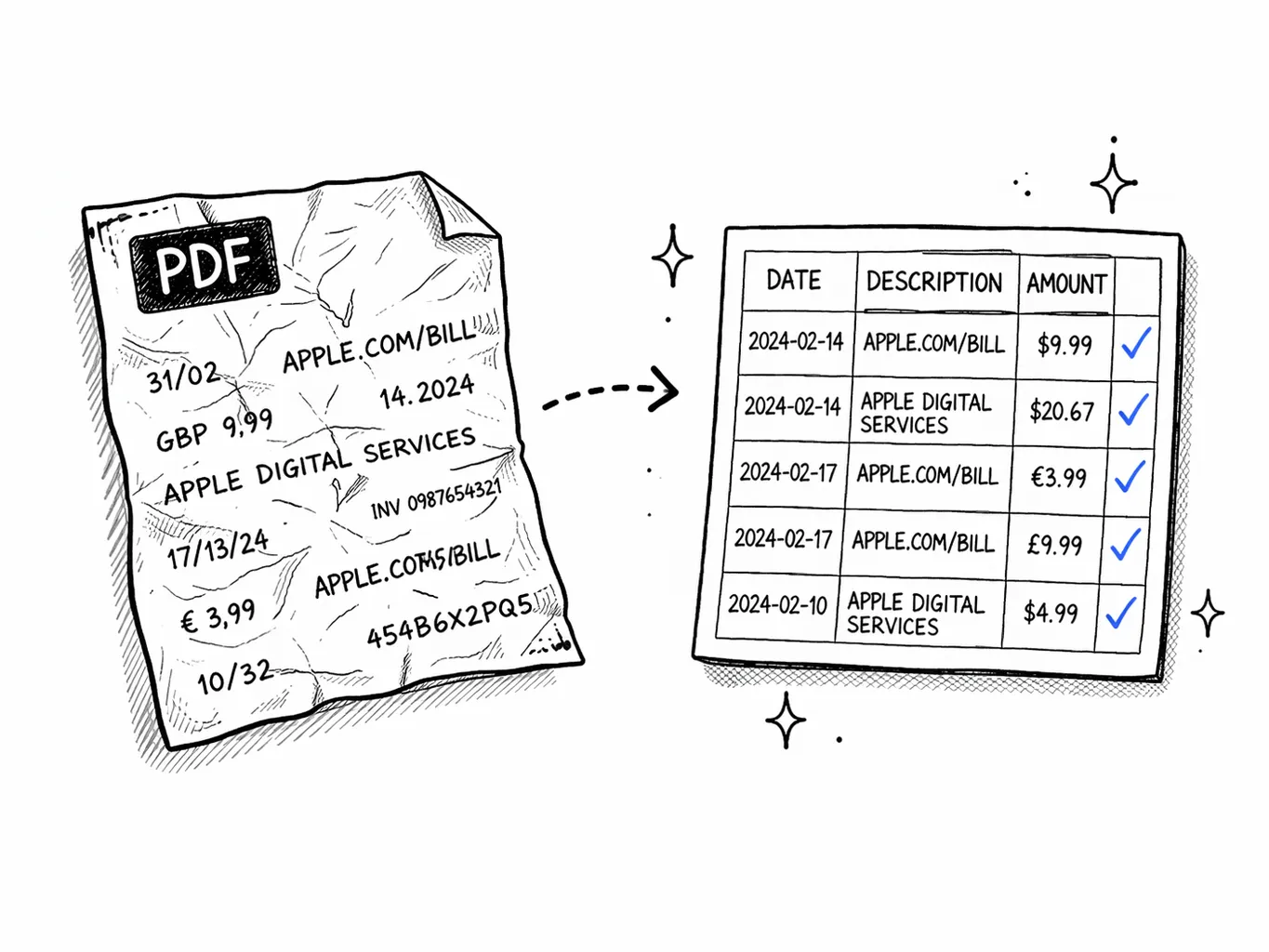
Date, payee, amount, and spending category — all structured into QIF format that Quicken reads natively.
Download QIF & import
Download the .qif file. In Quicken: File → Import → QIF File. In QuickBooks Desktop: File → Utilities → Import → QIF.
Format comparison
QIF vs CSV — which one do you need?
TL;DR: Use QIF for Quicken and QuickBooks Desktop. Use CSV for QuickBooks Online and spreadsheets.
Native import
QIF means one-click import — no mapping
When you import a CSV into Quicken, you have to map columns manually every time. QIF eliminates this — the format tells Quicken exactly what each field is. File → Import → QIF and you're done.
Our converter produces QIF files with proper date formatting, signed amounts, payee names from your statement, and AI-assigned categories in the L field. Quicken's memorized payee matching kicks in automatically.
Who needs bank statement to QIF
Anyone importing bank transactions into Quicken or QuickBooks Desktop.
Quicken users
Import bank statements directly — auto-matches memorized payees and populates categories.
QuickBooks Desktop
QIF is the native import format for QuickBooks Pro, Premier, and Enterprise editions.
GnuCash users
GnuCash has a built-in QIF import wizard — the easiest way to get bank data in.
Banks without feeds
When your bank doesn't support direct connect, QIF from PDF is the next best thing.
Why QIF is still the best format for Quicken
QIF has been around since the 1990s, but it remains thenative import formatfor Quicken and QuickBooks Desktop. Unlike CSV, which requires manual column mapping on every import, QIF files tell the software exactly what each field means — date, amount, payee, category, check number. One click and your transactions are in.
Our converter takes your bank statement PDF and produces aproperly formatted QIFwith every transaction extracted by AI. The L (Category) field is populated with one of 19 spending categories, which maps directly to your Quicken category list. The P (Payee) field preserves the merchant name so Quicken'smemorized payee matchingkicks in automatically — so repeat vendors are categorized correctly from the second import onward.
This workflow is especially valuable when your bank doesn't support Quicken's Direct Connect or Web Connect features. Instead of manually entering transactions, you download your PDF statement, convert it here in 30 seconds, and import the QIF. Works with any bank worldwide — Chase, Barclays, Deutsche Bank, HDFC, and thousands more.

Secure
Your PDF is processed in memory and never saved to disk. All data is encrypted in transit.

Private
We never sell or share your financial data. Anonymous uploads are auto-deleted after 7 days.

Transparent
No hidden fees, no account required. Try it without an account, or create a free account for 1 analysis per month.
Pricing
Pick by volume
One-time for a single report. Basic for regular files. Pro for heavy statements.
- 500 PDF pages per month
- Up to 100 visible transactions per report
- Subscription and recurring charge detection
- AI explanations for spending patterns
- 12-month analysis history
- Unlimited PDF pages
- Unlimited visible transactions per report
- Receipt scanning (5/mo)
- Priority support
FAQ
Bank statement to QIF — FAQ
Ready?
Upload one statement.
Get the full picture.
No credit card. No account. Drop a PDF and see every transaction categorized in 30 seconds.
Try it free →Related reading
QIF Format Explained
What QIF files contain, how Quicken reads them, and when to use QIF vs OFX or QBO.
Bank Statements for Self-Employed
What lenders and HMRC want to see from sole traders and freelancers.
Import Bank Statement to Xero / QuickBooks
Step-by-step guide to importing CSV, QIF, and OFX into accounting software.